Online Store vs Physical Store: Choose One or Combine Both?
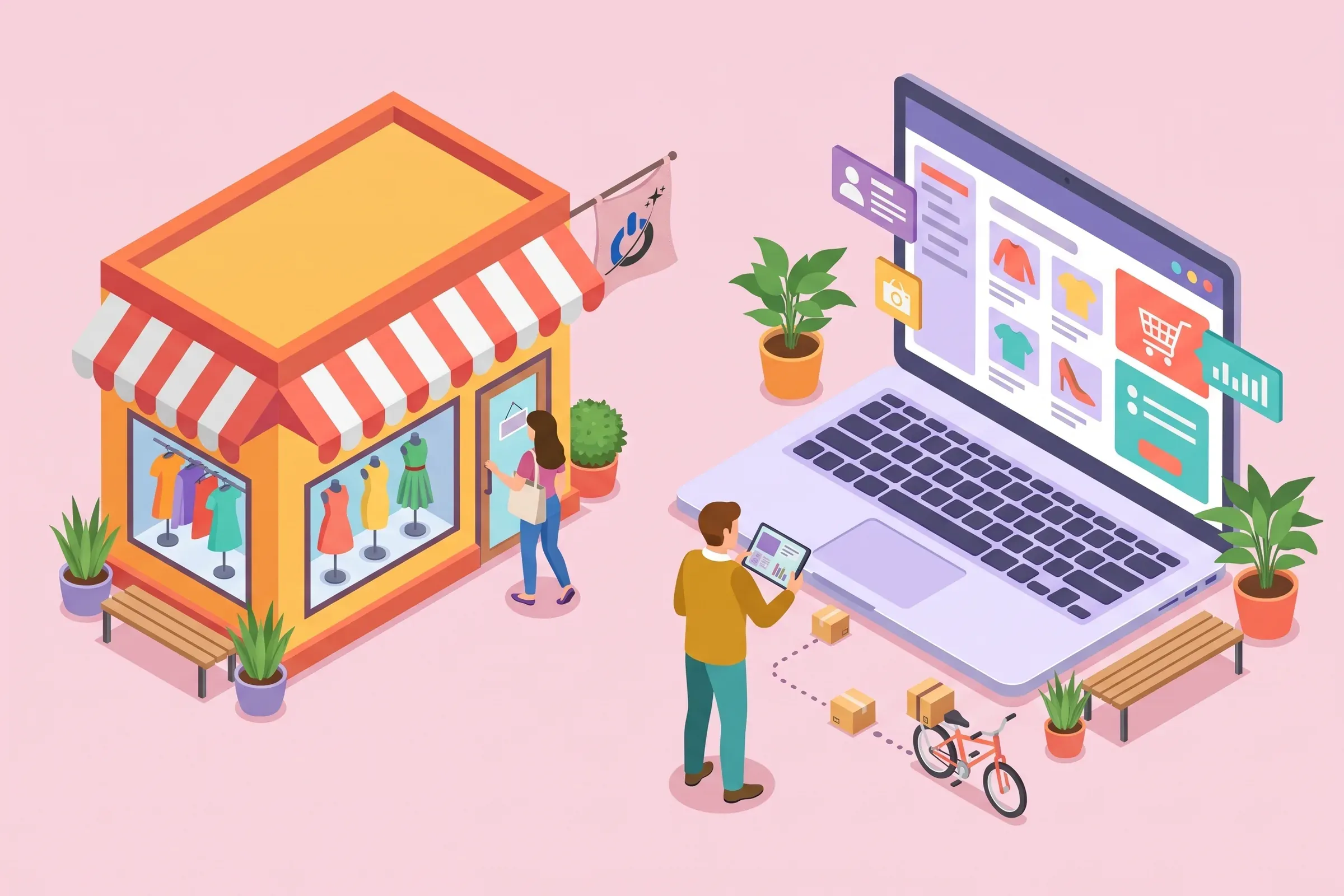
This guide compares an online store vs physical store on what matters to a retailer: costs, reach, customer experience, prices, logistics and margins. You will also find the cases where a single channel is enough, how to connect online and in-store sales without doubling your workload, and a short quiz to help you decide where to start. Whether you already run a physical store or are planning a new business, the goal is the same: make an informed choice, or decide to combine the two.
At a glance
- Online store vs physical store: the online store wins on reach and availability, the physical store on contact, trial and trust.
- Ecommerce costs less to open than retail premises, but you must pay for traffic acquisition and logistics.
- Physical stores remain strong for expensive, sensory or urgent purchases.
- Linking both channels (shared stock, click and collect, local SEO) creates more sales opportunities.
- The right choice depends on your products, your catchment area and the time you can give each channel.
Online store vs physical store: what are we comparing?
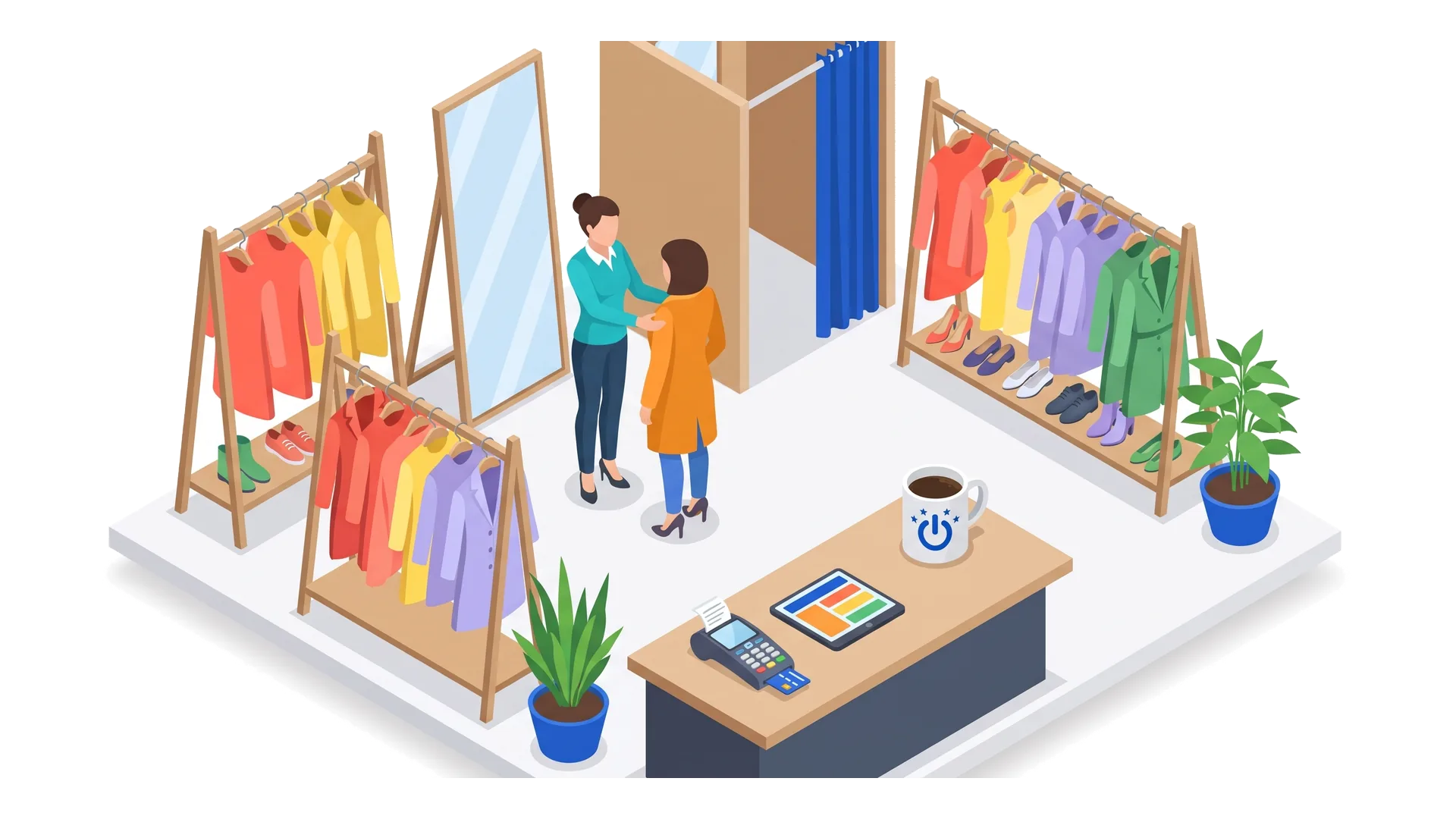
An online store is an ecommerce website where customers browse the catalog, pay and get their order delivered (or pick it up), without direct contact with a salesperson. A physical store, or brick-and-mortar store, is retail premises where customers see, touch and buy products on the spot, with staff on hand.
Between the two, every shade now exists: the store that shows its stock online, the online-born brand that opens a pop-up shop, the in-store pickup of an order placed on the website. Framing it as a contest therefore makes less sense than it used to. The real decision is about your main channel, the one that should carry most of your revenue at first, and how the other channel supports it.
Online store vs physical store: comparison table
Before going into detail, here are the two channels side by side on the criteria that weigh most in the decision.
| Criterion | Online store | Physical store |
|---|---|---|
| Opening hours | open around the clock | store hours |
| Catchment area | whole country, even abroad | neighborhood, city, region |
| Startup cost | lower (website, hosting) | high (premises, fit-out, stock) |
| Visibility | to build: SEO, ads, social media | shop window and foot traffic |
| Trying the product | impossible before delivery | see, touch, try |
| Advice | product pages, reviews, chat | face-to-face sales staff |
| Time to purchase | delivery in one or more days | instant purchase |
| Logistics | picking, shipping, returns | sale at the counter |
| Range | extended catalog | limited by floor space |
Neither channel wins across the board. The web wins on reach, opening hours and range; the store on sensory experience, advice and instant purchase. That complementarity is precisely what drives most retailers toward a mixed model.
Why online sales keep growing
Figures from Fevad, the French ecommerce federation, illustrate a market that has matured but is still growing: online sales in France reached 196.4 billion euros in 2025, up 7% on 2024, across 3.2 billion transactions. People buy online more often, but the average basket is shrinking, at around 62 euros. Similar trends appear in Belgium, Switzerland, Canada and most mature markets, with strong competition from large marketplaces.
Buy anywhere, anytime
An online store never closes. It sells on Sunday evenings, on public holidays and while you sleep. For a busy or distant customer, that is often the deciding factor: no travel, no opening hours, no queue.
A catchment area without borders
A store lives off its street, neighborhood or city. An online store can reach an entire country, or several. For a niche offer (spare parts, handmade goods, rare sizes), it is sometimes the only way to find enough customers.
A wider range, without shelf space
Online, you can list products you would never have room to display: variants, sizes, colors, items ordered from the supplier on demand. Customers find more choice, and you avoid tying up cash in store inventory.
Easy comparison before buying
Detailed product pages, customer reviews, price and delivery comparisons: online shoppers decide at their own pace. That is also a risk for you, since they can compare with your competitors in two clicks. A clear product page, good photos and well-explained delivery make the difference.
What a physical store offers that the web cannot replace
A brick-and-mortar store keeps strengths that no website, however well designed, can fully reproduce.
See, touch, try
Holding a garment, sitting on a sofa, smelling a fragrance, feeling the weight of a tool. For sensory or expensive products, trying removes the last doubts. Online, that doubt turns into abandoned carts and returns.
Advice from a salesperson
A good salesperson understands a vague need (“I want a jacket, but not too warm, I walk a lot”) and suggests a product the customer would not have considered. PwC research on customer experience shows that a large majority of consumers want to keep human interaction, even when part of the purchase happens online.
Instant purchase
A last-minute gift, a forgotten charger, a part needed for a repair today: in store, customers leave with their purchase. No delivery time, no parcel to wait for.
Trust for major purchases
For jewelry, a home appliance or furniture, many customers prefer to pay in front of someone who will answer if something goes wrong. A store reassures, which matters even more when the brand is young or little known.
A local presence that builds loyalty
A physical store creates a bond with its neighborhood: regulars, word of mouth, in-store events. It is also a visibility asset on Google, through the business profile and customer reviews.
Costs: opening an online store or a physical store
Opening an online store usually costs less than opening retail premises, but the comparison does not stop at startup costs. Here are the items to plan for on each side.
| Item | Online store | Physical store |
|---|---|---|
| Opening | website build, photos, product pages | lease, deposit, works, furniture |
| Fixed costs | hosting, maintenance, subscriptions | rent, energy, insurance, wages |
| Visibility | SEO, advertising, social media | shop window, signage, Google listing |
| Payments | fees on every transaction | card terminal, till |
| Logistics | packaging, shipping, returns | store restocking |
| Management time | orders, customer service, content | time in store, shelving |
The most common online trap is believing that a good website is enough. Without SEO, advertising and content, an online store has no passers-by. A store’s rent partly pays for its visibility (the window, the street); online, that visibility is built and paid for differently, in time or in acquisition budget.
Online vs in-store prices: where do the gaps come from?
Prices are often slightly lower online, and that is no accident. A website has no retail rent or full-time sales staff, and large platforms squeeze their margins to gain market share. For store-brand products, the gap tends to come from promotions reserved for the website or drive-through pickup.
In store, fixed costs are heavier, but there are no shipping costs or returns to absorb. For a retailer selling on both channels, our advice is simple: keep prices consistent. A large gap pushes customers to try in store and then order elsewhere. It is better to have the same price and benefits specific to each channel (free shipping above a certain amount online, services or alterations in store).
Customer experience: comparing in-store and online shopping
The online experience relies on speed, choice and autonomy; the in-store experience on emotion, advice and immediacy. Both have friction points: delivery times and returns online, opening hours and stockouts in store.
Customers no longer think in separate channels. Many search online before visiting (known as web-to-store or ROPO, research online, purchase offline), while others try in store before ordering on the website. If your site shows neither your hours, your address nor product availability, you lose some of these customers just when they are ready to come.
Ready to open or modernize your online store? Discover our website design services
Logistics, stock and after-sales service
In store, stock is in front of you and the sale closes at the counter. Online, every order triggers a chain: picking, packing, shipping, tracking, returns, refunds. You must also follow distance-selling rules (pre-contract information, withdrawal rights, terms and conditions), which vary by country.
When both channels coexist, stock synchronization becomes the key issue. A product sold in store must disappear from the website right away, otherwise you sell online what you no longer have. That is where a point-of-sale system connected to your website changes everything.
When to choose an online store only
Going fully online makes sense in several situations:
- your products are standard, easy to describe and easy to ship;
- your customers are spread out geographically or your offer is niche;
- you are launching a brand on a limited budget and want to test demand;
- you sell digital products, subscriptions or bookable services.
In that case, focus your budget on website quality, product pages and acquisition. The platform choice matters a lot: Shopify, WooCommerce and PrestaShop each have their strengths, as explained further down.
When to keep a physical store without selling online
A store alone remains relevant when most of the value is created on site: food retail, personal services, highly customized products, in-depth technical advice. Even then, a minimal online presence is essential. Customers look you up on Google before they visit: an up-to-date business profile and a clear showcase website are often enough. If you are torn between presenting your products and actually selling them online, our brochure website vs ecommerce comparison will help you decide.
Combining online and in-store sales: the winning model
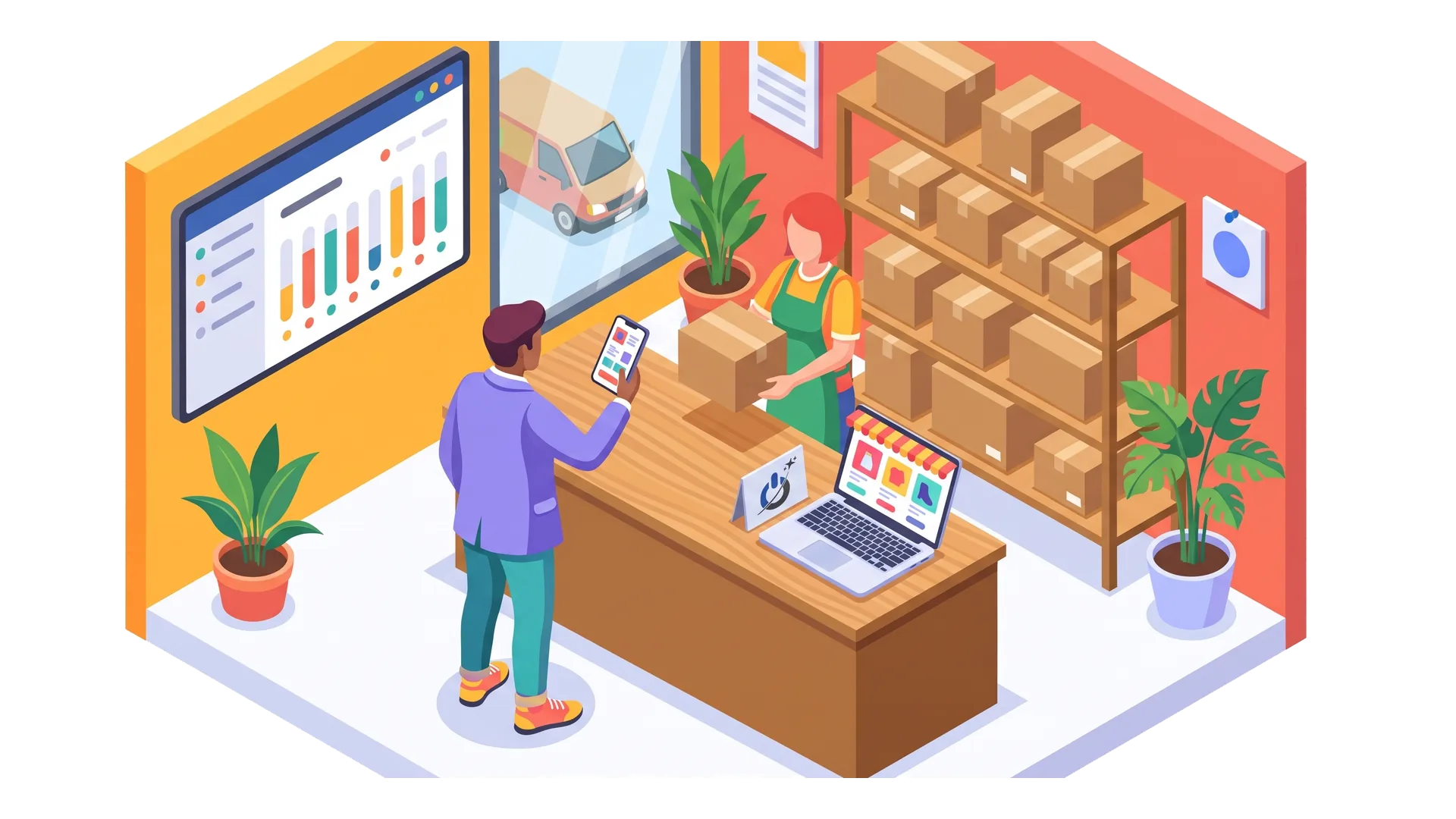
For most retailers who already have premises, the question is no longer online store vs physical store, but how to make the two work together. The website attracts and informs, the store reassures and closes, and each sends customers to the other. Here are the steps we follow with our clients.
Which solution connects a store and an online shop?
Shopify offers its own point of sale, Shopify POS, which shares stock and customer records with the online store: it is the simplest way to bring a physical store online with Shopify, or the other way round. WooCommerce and PrestaShop connect to POS software through modules or connectors, with more freedom but a little more setup. The right choice depends on the number of products, the number of locations and the tools already in place (accounting, ERP). Our Shopify team and our WooCommerce and PrestaShop developers can help you choose.
Bringing online shoppers into your store
Web-to-store relies on a few simple levers:
- a complete Google Business Profile (hours, photos, reviews, products);
- local pages on your website, with address, directions and in-store services;
- in-store availability shown on product pages;
- free click and collect and online appointment booking;
- online purchases returnable in store, which creates another sales opportunity.
Local SEO, covered by our SEO services, is often the most profitable lever for a physical store: it reaches people who are already looking for a business like yours, close to them.
Quiz: online, in store or both?
Answer these few questions for a first indication. It does not replace market research, but it helps set the right priorities.
Common mistakes when combining both channels
- Unsynchronized stock: online sales of products already sold in store, cancellations and disappointed customers.
- Inconsistent prices: customers feel cheated and compare everything.
- A website without practical information: no address, hours or availability, although that is what local customers look for.
- Store staff left out: salespeople see the website as a competitor instead of a tool.
- No measurement: without tracking per channel, you cannot know what the website really brings in.
Measuring what each channel brings in
A strategy that links online and in-store sales works when customers move naturally from one channel to the other and come back to buy. Track at least revenue per channel, the share of orders picked up in store, the share of customers buying on both channels, purchase frequency and visits generated by your Google listing. Google Analytics 4, your CRM and a POS connected to the website let you cross-check this data.
Conclusion
Should you choose between an online store and a physical store? For a launch with limited resources and products that are easy to ship, an online store is often the most sensible starting point. For a business built on advice, proximity or sensory products, the physical store remains the heart of the model. And for most established retailers, the best answer is to connect the two: a website that attracts and informs, a store that reassures and builds loyalty, shared stock and shared customers.
Frequently asked questions about online stores vs physical stores
Is an online store really cheaper to start than a physical store?
An online store usually costs less to open than a physical store, because it avoids retail rent, store fit-out and many fixed costs. You still need to budget for the website build, hosting, maintenance, logistics and above all traffic acquisition (SEO, advertising, social media). Without that acquisition budget, an online store remains invisible.
Is click and collect still useful in 2026?
Yes. Many customers are used to ordering online and picking up in store, with no shipping fees and no waiting. The service links the online store directly to the physical location, drives foot traffic and encourages extra purchases on site. It requires synchronized stock and fast order preparation.
What is omnichannel retail?
Omnichannel retail unifies every touchpoint of a brand: store, ecommerce website, app, social media and customer service. Customers find the same products, prices, stock and loyalty benefits whatever the channel. Unlike multichannel, where each channel works separately, omnichannel shares data to offer a seamless journey.
Which solution should I choose to connect a store and an online store?
You need an ecommerce solution that can sync stock, orders and customers with the store’s point of sale. Shopify offers its own POS, while WooCommerce and PrestaShop connect to POS software through modules or connectors. The right choice depends on the number of products, the number of locations and the management tools already in place.
How do I bring online customers into a physical store?
Start by making the store visible online with a complete Google Business Profile and good local SEO. The website can then show in-store availability, offer pickup, appointment booking or in-store-only offers. Accepting returns of online purchases in store also creates sales opportunities.
How can I tell whether an omnichannel strategy really works?
It works when customers move between channels and come back to buy. Track revenue per channel, the share of orders picked up in store, purchase frequency, the rate of repeat customers and satisfaction. Google Analytics 4, a CRM and a POS connected to the website let you cross-check this data and measure what each channel really brings.
Can Aurone build my online store and connect it to my physical shop?
Yes. Aurone builds online stores on WooCommerce, PrestaShop and Shopify, with the features that connect your website to your physical shop: in-store pickup (click and collect), in-store availability and local SEO for your Google listing. See our website design services.