Google RankBrain: How Google’s AI Understands Searches, and What It Means for SEO

This guide explains Google RankBrain in plain terms: what it is, how it interprets queries, where it sits in the Google algorithm alongside BERT, neural matching and AI-generated answers, and above all what it actually changes for your SEO in 2026.
At a glance
- RankBrain is an artificial intelligence system Google has used since 2015 to better understand queries and rank results.
- It links the words in a search to concepts, so relevant pages can be found even without the exact words of the query.
- RankBrain is just one piece of the algorithm, alongside BERT, neural matching, passage ranking and many other systems.
- You don’t optimize “for RankBrain”: you write content that clearly answers search intent, with natural, complete vocabulary.
- The same principles apply to Google’s AI-generated answers and to optimizing for AI search engines (GEO).
What is RankBrain?
RankBrain is the name of an artificial intelligence system built into Google’s search algorithm. Its job: help the search engine understand how the words in a query relate to real-world concepts, in order to rank results as well as possible.
In its guide to ranking systems, Google describes it as an AI system that helps it understand how words are related to concepts. In practice, this lets Google return relevant content even when it doesn’t contain all the exact words used in the search.
Google launched RankBrain in 2015; it was the first deep learning system deployed in Search. According to Google, it remains one of the major AI systems powering Search today.
Machine learning and artificial intelligence: what are we talking about?
Artificial intelligence covers the techniques that let a machine perform tasks associated with human intelligence: understanding text, recognizing an image, making a decision.
Machine learning is a branch of it: instead of writing every rule by hand, you give the system many examples and it works out the patterns itself. Deep learning is a form of machine learning based on multi-layer neural networks. RankBrain belongs to this family.
How does RankBrain work?
Before RankBrain, search engines relied mainly on word matching: a page was relevant if it contained the query’s terms. The problem: a large share of searches are phrased in unique ways, with casual wording, typos or rare words.
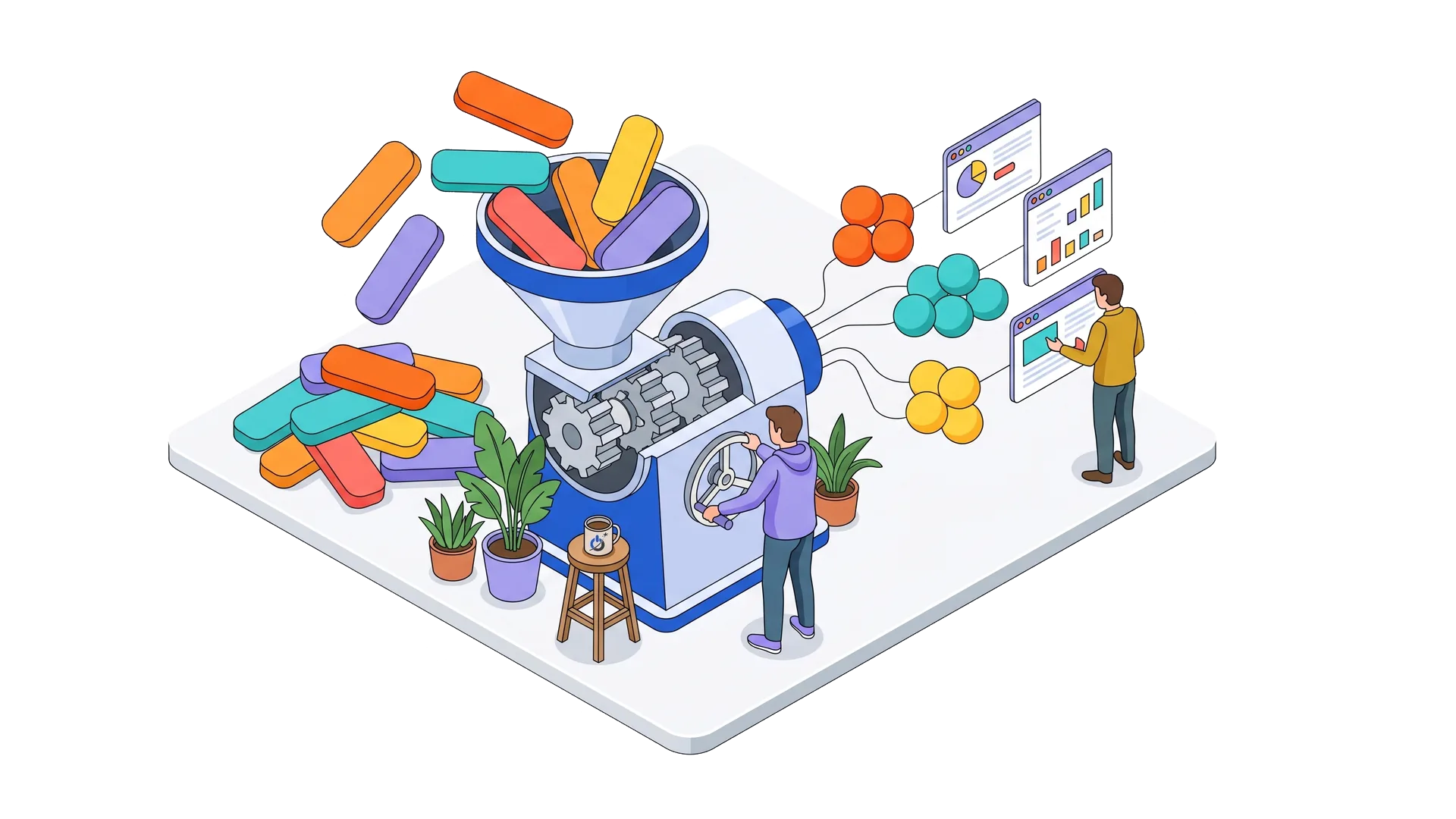
RankBrain represents words and queries as concepts. When a search is unusual, it connects it to queries and pages that express the same idea in other words. It then helps decide the order of the top results.
| Query typed | What Google understands | Pages that can rank |
|---|---|---|
| what is the predator at the top of the food chain | the concept of an “apex predator” | pages about apex predators, even without the exact phrase |
| my site dropped on google since the update | a ranking loss after an algorithm update | pages about SEO traffic drops and Google updates |
| how much for a website for my restaurant | the cost of a restaurant website | pricing pages and cost guides for restaurants |
RankBrain in the Google algorithm: one piece among many
RankBrain is not “the Google algorithm”. Google uses many automated ranking systems that look at a multitude of factors and signals across hundreds of billions of pages. Several rely on AI and complement each other:
| System | Since | Role |
|---|---|---|
| RankBrain | 2015 | link the words of a query to concepts and help rank the best results |
| Neural matching | 2018 | match the concepts in a query with those in pages to retrieve relevant documents |
| BERT | 2019 | understand how the combination and order of words change meaning and intent |
| Passage ranking | after BERT | identify the specific section of a page that answers the question |
| Link systems (PageRank…) | from the start | use links between pages to judge their importance |
| Helpful and reliable content systems | evolving | favor helpful, original and reliable content |
In 2015, statements reported in the press described RankBrain as the third most important ranking signal. Google no longer publishes this kind of ranking, and RankBrain now works alongside newer AI systems. The key idea to remember: Google increasingly understands the meaning of a search, not just its words.
The names that shaped SEO history (PageRank for links, Panda for content quality, Penguin against artificial links, Pigeon for local search) refer to other components or updates, several of which are now built into the core algorithm.
What RankBrain changes for your SEO
You can’t “optimize for RankBrain” in a technical sense: there is no tag and no setting. It does, however, reward a way of writing. Here is what we recommend:
- Start from search intent: what does the person typing this query really want? A definition, a comparison, a price, a tutorial? Your page should answer it directly.
- Write naturally, for a reader: forced keyword repetition no longer helps. Use your topic’s vocabulary, synonyms and the related terms your customers use.
- Cover the whole topic: address the related sub-questions. A complete page matches more different phrasings.
- Structure clearly: an explicit title, subheadings that reflect the questions, short answers then details.
- Look after the experience: a slow, confusing or ad-heavy page disappoints the reader, however good the text.
- Target long queries: RankBrain helps Google understand specific, unusual searches. These often bring highly qualified visitors.
To put these principles into practice, see our guide to blogging for SEO, and start with an SEO audit to find the pages that fall short.
Do your pages really match your customers’ intent? Discover our SEO services
RankBrain, BERT, MUM: what’s the difference?
These systems build on and complement each other more than they replace one another. RankBrain (2015) links words to concepts to rank results. Neural matching (2018) matches the concepts in a query with those in pages to find relevant documents. BERT (2019) understands how the order and combination of words change a sentence’s meaning, including small words like “for” or “without”. MUM, introduced later, is a more powerful model used for targeted purposes, able to handle several languages and formats.
What about generative AI in search in 2026?
Since RankBrain, AI has become far more visible: Google now shows AI-generated answers above some results, and assistants such as ChatGPT or Perplexity answer questions directly while citing sources. The principle is the same: these systems look for the pages that answer a question most clearly and reliably.
The good practices that worked with RankBrain therefore still apply: answer the intent, structure, cite sources, show expertise. They are at the heart of optimizing for AI search engines, or GEO (Generative Engine Optimization).

Checklist: is your content understood by Google’s AI systems?
Key takeaways
Google RankBrain is the artificial intelligence system Google has used since 2015 to link query words to concepts and rank results better, including for never-before-seen searches. It now works with other AI systems such as neural matching and BERT, and generative AI has joined the results page. For your SEO, the conclusion is simple: you don’t optimize for an algorithm, you answer what your customers are looking for clearly, completely and naturally.
Frequently asked questions about RankBrain and AI in Google rankings
Does Google still use RankBrain in 2026?
Yes. Google still lists it in its guide to ranking systems and presents it as one of the major AI systems in Search. It works alongside newer systems such as neural matching and BERT. Its role remains to link query words to concepts in order to rank results better.
What is the difference between RankBrain, BERT and MUM?
RankBrain (2015) links words to concepts to rank results. BERT (2019) understands how the combination and order of words change a sentence’s meaning. MUM is a more powerful, multilingual and multi-format model used for specific purposes. They complement each other rather than replace one another.
How do you optimize content for RankBrain?
There is no technical setting specific to RankBrain. Answer the search intent directly, write naturally with your topic’s vocabulary, cover related questions and structure the page with clear subheadings. A useful, well-organized page is the one Google’s AI systems understand best.
How is artificial intelligence changing Google search results?
It lets Google understand the meaning of queries rather than just spotting words, and find relevant pages even when they are phrased differently. It is also used to generate summary answers above some results. To stay visible, you need clear, reliable content that is easy to cite.
What is search intent in SEO?
It is the real need behind a query: learning something, comparing, buying, finding a specific site or a nearby business. Google ranks pages by how well they meet that need. Identifying the intent before writing is the foundation of good SEO.
What is GEO, or optimizing for AI search engines?
GEO, for Generative Engine Optimization, means making your content easy for AI engines such as Google’s generated answers, ChatGPT or Perplexity to understand and cite. It rests on the same foundations as SEO: clear answers, structure, sources, visible expertise and up-to-date information.