SEO Log File Analysis: How Googlebot Really Crawls Your Site

SEO log file analysis means using these files to understand how search engine bots crawl your pages: which ones they visit, how often, which ones they ignore and where they waste time. It is a valuable technical diagnostic for sites with hundreds of pages, online stores and sites that recently changed structure.
This guide explains what server logs are, how to read a log line, which metrics to track, how to verify that a visitor really is Googlebot, which tools to use and how to turn log file analysis into concrete fixes. A decoder lets you read a line from your own logs as you paste it.
At a glance
- SEO log file analysis studies server files to see which pages bots really crawl.
- Each log line records the IP, date, requested URL, HTTP status and user agent.
- Logs reveal wasted crawling: parameters, filters, redirects and errors.
- A visitor claiming to be Googlebot must be verified with a reverse DNS lookup.
- Logs also show AI crawlers such as GPTBot and ClaudeBot.
What are server logs?
A server log (or access log) is a text file in which the web server records every request it receives: a page, an image, a CSS file, an API call. Apache, Nginx and most hosts use a standard format called “combined” by default. One line equals one request, whether it comes from a person, Googlebot, an SEO tool or a malicious bot.
Classic SEO tools simulate a crawl or receive aggregated data (Search Console). Logs record what actually happened, request by request. They answer questions no other tool settles with certainty: has Google crawled this new page? How often does it come back to my categories? Why does it spend so much time on parameter URLs?
How to read a log line
Here is a typical line in combined format, and what each field brings to log analysis:
66.249.66.1 - - [12/Nov/2026:08:14:03 +0100] "GET /blog/example/ HTTP/1.1" 200 18432 "-" "Mozilla/5.0 (compatible; Googlebot/2.1; +http://www.google.com/bot.html)"| Field | Example | What it tells SEO |
|---|---|---|
| IP address | 66.249.66.1 | Who made the request (verify it for Googlebot) |
| Date and time | 12/Nov/2026:08:14:03 +0100 | How often and how recently bots visit |
| Request | GET /blog/example/ | The URL crawled, parameters included |
| HTTP status | 200 | Server response: success, redirect, error |
| Size | 18432 | Response weight, useful to spot anomalies |
| Referrer | – | Source page (usually empty for bots) |
| User agent | Googlebot/2.1 | Declared bot or browser |
Decode a line from your logs
Paste a line from your own logs: the tool splits the fields, explains the HTTP status and identifies the declared bot.
HTTP status codes to watch
The status code is often the most telling signal. A high share of redirects or errors in Googlebot’s requests points to a structural or server problem.
| Code | Meaning | SEO action |
|---|---|---|
| 200 | Page served | Check that the crawled pages are the useful ones |
| 301 / 302 | Redirect | Point internal links to the final URL, avoid chains |
| 304 | Not modified | Normal: the bot reuses its copy and saves resources |
| 404 / 410 | Not found or gone | Fix internal links, redirect if an equivalent page exists |
| 5xx | Server error | High priority: Google slows crawling if errors repeat |
| 429 / 503 | Server overloaded or unavailable | Check capacity, firewall and anti-bot rules |
Log files and crawl budget
Google does not crawl every page of every site all the time. It adjusts crawling to server capacity (fast, error-free responses) and to its interest in the pages (popularity, freshness). This is known as crawl budget.
For a 30-page brochure site, crawl budget is almost never an issue. It becomes one for sites with thousands of URLs, especially stores with filters and sorting options, where the number of possible combinations explodes. Logs then show exactly where the budget goes: if Googlebot spends a large share of its visits on parameter URLs or redirected pages, your important pages get crawled less often.

Verifying that a visitor really is Googlebot
Anyone can write “Googlebot” in their user agent, and scrapers and malicious bots often do. Before drawing conclusions, verify the IP address. Google recommends two methods:
- Reverse DNS lookup: the IP must resolve to a hostname in googlebot.com, google.com or googleusercontent.com, and that hostname must resolve back to the same IP.
- Published IP ranges for Google’s crawlers, matched automatically against your logs.
SEO log file analysis: practical use cases
Spot crawling of useless pages
Group the URLs Googlebot crawls by type (products, categories, articles, parameter URLs, internal search, files). If filters, sorting or internal search URLs make up a large share of requests, act on internal links, canonical tags and robots.txt rules for low-value areas. Before blocking anything, check that no useful page depends on it.
Find pages that are never crawled
Compare the URLs in your sitemap (or a full crawl) with those seen in 30 days of logs. An important page Googlebot never visits is usually poorly linked: too deep, without internal links from strong pages, or orphaned.
Check errors and redirects
Filter Googlebot requests returning 404, 5xx and 301. Recurring 404s point to links to fix. 5xx errors, even rare ones, deserve attention: a server that fails while Google crawls limits its crawling. After a redesign or migration, logs are the best way to confirm that Google follows the redirects.
Track new and updated pages
After publishing content, logs show the exact day Googlebot first crawled it, a good indicator of internal linking quality.
Need a diagnosis of how Google crawls your site? Explore our technical SEO services
AI crawlers in your logs
Logs also show AI crawlers: GPTBot, OAI-SearchBot and ChatGPT-User (OpenAI), ClaudeBot (Anthropic), PerplexityBot and others. Tracking them shows which pages they read and how often, so you can decide on an informed basis whether to allow or block them in robots.txt. Some tokens, such as Google-Extended, are not separate crawlers: they only express a choice in robots.txt and never appear in logs. See also our guide to generative engine optimization.
Server logs or Search Console?
Search Console’s Crawl Stats report gives a useful summary: requests per day, average response time, breakdown by response code and file type. It is an excellent free starting point that needs no technical access. But it only shows a sample of URLs and covers Google alone. Logs are exhaustive, cover every bot and can be matched URL by URL with your own data. The two complement each other.
Log analysis tools
| Tool | Type | Best for |
|---|---|---|
| Crawl Stats report (Search Console) | Free, aggregated Google data | A first look, without log access |
| Screaming Frog Log File Analyser | Desktop software | Small and mid-size sites, one-off analyses |
| Seolyzer | Online service | Continuous monitoring |
| Oncrawl, Botify | SaaS platforms | Large and ecommerce sites, crawl and log data combined |
| GoAccess, ELK stack (Elasticsearch, Kibana) | Open source | Technical teams, custom dashboards |
| Spreadsheet or script | Manual | Small volumes, specific questions |
A 6-step method
- Collect at least 30 days of logs from your host or server (CDNs and caches may keep their own logs).
- Filter the bots you care about and verify Googlebot IPs.
- Group URLs by page type or directory.
- Cross-check with a crawl and the sitemap.
- Prioritize anomalies: errors, redirects, wasted crawling, slow responses.
- Fix, then measure again 4 to 6 weeks later.
Logs contain IP addresses, which are personal data: limit retention, restrict access and anonymize them before sharing with a provider.
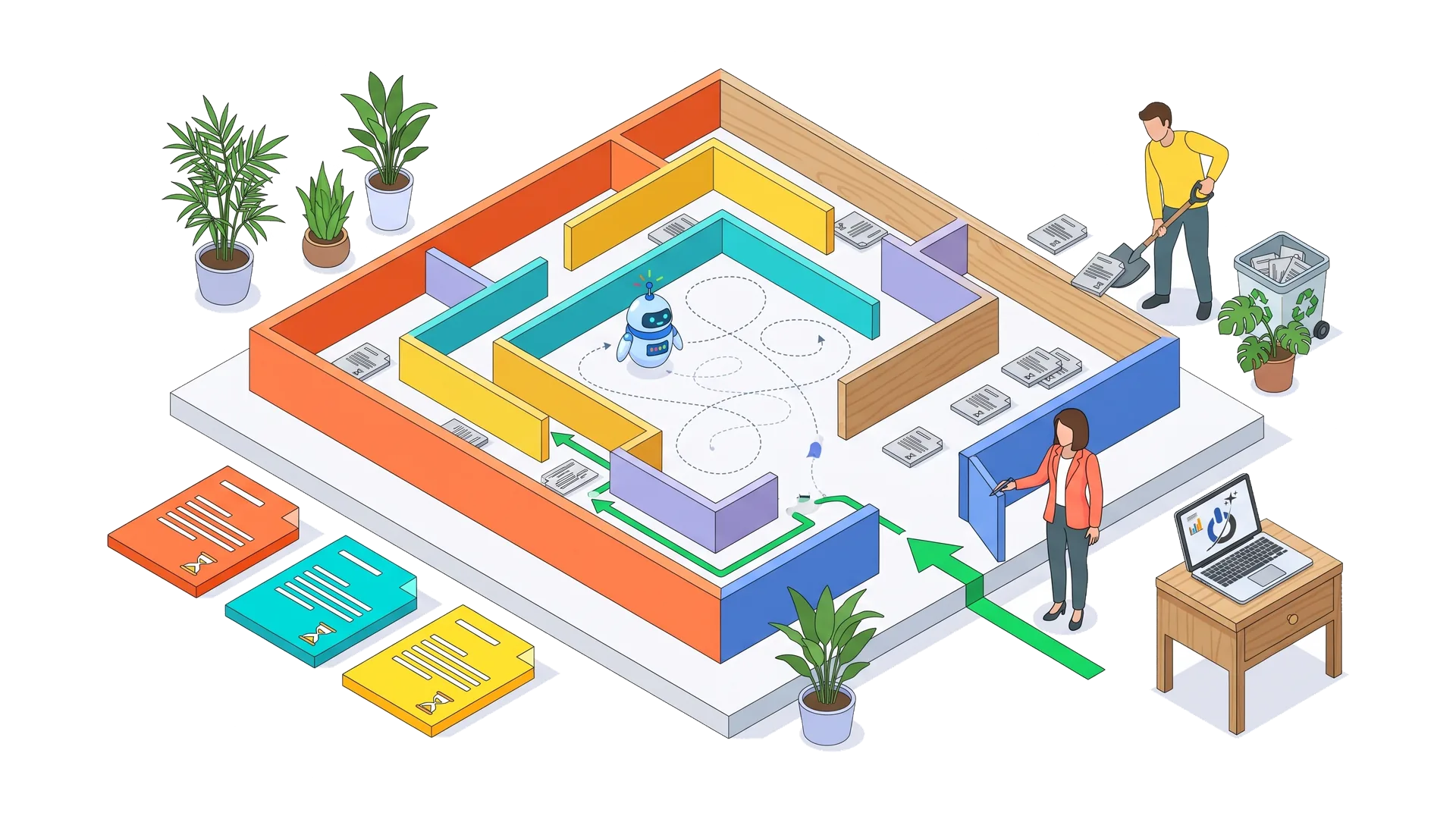
Conclusion: measure instead of guessing
Log file analysis gives a direct view of how bots behave on your site. It does not replace Search Console or a crawler, but it confirms or corrects their assumptions: pages actually crawled, wasted budget, errors seen by Google, the effect of a redesign, AI crawler activity. For large sites it is often part of an SEO audit.
Our advice: start with the Crawl Stats report in Search Console, then collect 30 days of logs as soon as your site exceeds a few hundred pages or after any structural change.
Frequently asked questions about log file analysis
How often should you analyze SEO log files?
For most sites, a quarterly analysis is enough, plus a one-off analysis after each redesign, migration or large batch of new pages. Large ecommerce sites benefit from continuous monitoring with alerts on server errors and sudden crawl changes.
My host does not give me access to logs. What can I do?
Ask support: many hosts provide logs on request or in the customer area. Otherwise, the Crawl Stats report in Search Console gives a first view. If access is impossible on an important site, factor it into your choice of hosting.
Does log analysis replace Google Search Console?
No. Search Console provides impressions, clicks, indexing and a crawl summary from Google. Logs add the exhaustive detail of every request, for every bot. The two work together.
Which tools can you use to analyze server logs for SEO?
Screaming Frog Log File Analyser or a spreadsheet are enough for small volumes. Seolyzer, Oncrawl or Botify suit continuous monitoring and large sites. Technical teams can use open source options such as GoAccess or the ELK stack.
How do you verify that a visit really comes from Googlebot?
Run a reverse DNS lookup on the IP: it must return a hostname in googlebot.com, google.com or googleusercontent.com that resolves back to the same IP. You can also match IPs against the ranges Google publishes. The user agent alone proves nothing.
Can server logs track AI crawlers such as GPTBot or ClaudeBot?
Yes. These bots declare their name in the user agent, so you can see which pages they read and how often. As with Googlebot, verify IPs against the ranges their operators publish where available, then decide whether to allow or block them in robots.txt.