Ecommerce Trends 2026-2027: 8 Innovations to Watch for Your Store
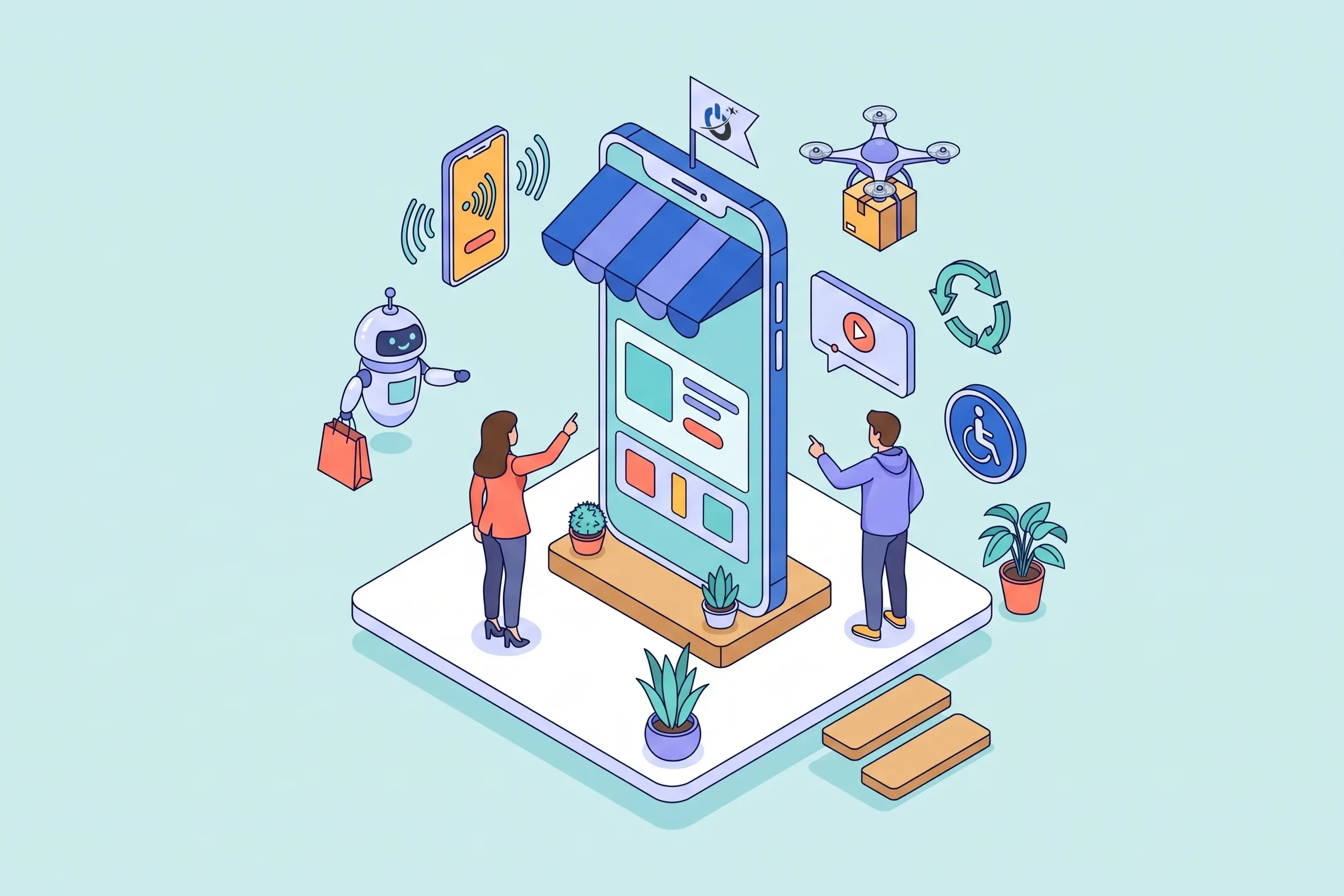
The ecommerce trends for 2026-2027 are not technology gimmicks: they change how customers discover, compare, pay for and receive products. Some are already legal requirements, like accessibility in the EU; others, like agentic commerce, are worth preparing for now.
This guide reviews the eight online shopping trends that matter for a store, what they change in practice and how to prioritize them. A 10-point self-check tells you whether your store is ready for the future of ecommerce.
At a glance
- Ecommerce trends for 2026-2027 are driven by AI, new payment methods, accessibility and first-party data.
- Agentic commerce lets an AI assistant recommend and buy a product for the customer.
- The European Accessibility Act has applied to many online stores since June 28, 2025.
- Shoppers buy more often but spend less per order, which makes every sale more expensive to win.
- Before chasing a trend, a store should get the basics right: product data, speed, delivery, returns.
The 8 major ecommerce trends to watch
| Trend | What is changing | Priority for a small business |
|---|---|---|
| Agentic commerce and conversational AI | AI assistants recommend and buy on the customer’s behalf | Prepare: clean catalog, structured data |
| Search and visibility in AI tools | Part of product discovery happens in ChatGPT, Gemini, Perplexity | Now |
| New payment methods and buy now pay later | Account-to-account wallets grow, installment payments get regulated | Depends on your customers |
| Digital accessibility | The European Accessibility Act has applied since June 2025 | Mandatory for many stores selling in the EU |
| Social commerce and video | Buying from social platforms and live video | Depends on your audience |
| Second-hand and sustainability | Refurbished, resale, eco-design of websites | Depends on your sector |
| First-party data personalization | Fewer third-party cookies, more consented customer data | Now |
| Delivery and logistics | Delivery times, pickup points, simple transparent returns | Always a priority |
1. Agentic commerce and conversational AI
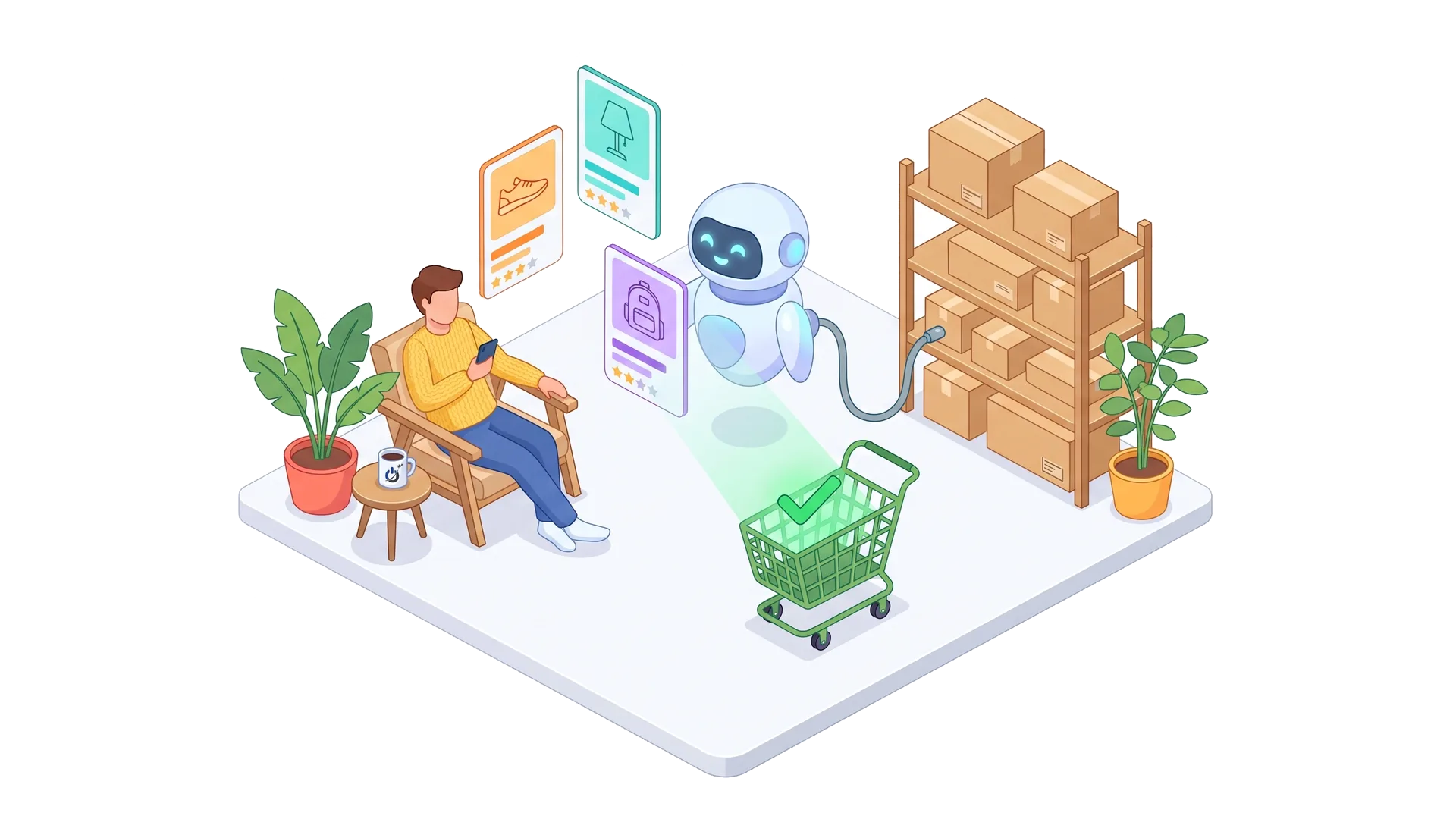
Agentic commerce refers to purchases made with the help of, or through, an AI agent. In September 2025, OpenAI launched Instant Checkout in ChatGPT in the US, starting with Etsy sellers and then Shopify merchants, and open-sourced the Agentic Commerce Protocol built with Stripe. Other players are preparing similar solutions.
For a store, preparation is mostly technical and editorial: a clean catalog, up-to-date product feeds, structured data (price, availability, reviews) and product pages that answer questions clearly. An agent does not pick a product for its photo, but for reliable, machine-readable information.
2. Visibility in AI answer engines
Before buying, many people ask ChatGPT, Gemini or Perplexity, or read Google’s AI Overview. Being cited requires useful, precise and well-structured content, a brand present on recognized sources and a sound technical base. See our guide to generative engine optimization.
3. New payment methods
Account-to-account wallets are growing in Europe (Wero has been opening to ecommerce since late 2025), and buy now, pay later remains popular while consumer credit rules tighten. Offer the payment methods your customers actually use in each market, not just cards.
4. Digital accessibility becomes mandatory
The European Accessibility Act has applied since June 28, 2025 to many ecommerce services sold in the EU, with an exemption for microenterprises. Contrast, keyboard navigation, alt text and accessible forms benefit every visitor and often improve conversion.
5. Social commerce and video
Social platforms are becoming places to buy: built-in shops, shoppable videos, live selling. For fashion, beauty, home or visual products it is a channel worth testing; for other sectors, a focused channel beats a scattered presence.
6. Second-hand and sustainability
Refurbished products, trade-ins and rentals are growing in many categories. Sustainability also applies to the site itself: a lighter, eco-designed store loads faster and uses fewer resources.
7. First-party data personalization
As third-party cookies fade and consent rules tighten, data collected directly from customers (accounts, email, purchase history, stated preferences) becomes the key asset for personalizing recommendations and reminders.
8. Delivery and returns
The trend that never goes out of style: clear delivery times, shipping choices, pickup points and simple returns. Shoppers compare these conditions as closely as prices.
Want to modernize your store? We modernize online stores
Is your store ready?
Where to start
- Fundamentals: mobile speed, complete product pages, visible costs and delivery times, simple returns. See our guide to ecommerce conversion rate.
- Obligations: accessibility, consent compliance, legal pages.
- Data: structured data, clean product feeds, consented email collection.
- New channels: AI visibility, social commerce depending on your audience, new payment methods.
For more growth levers, see how to increase online sales.

Mistakes to avoid
- Adopting technology because it is trendy, with no link to your customers.
- Stacking apps and plugins that slow the store down.
- Ignoring accessibility as if it only concerned large sites.
- Relying on a single channel (one marketplace, one social network, one ad platform).
- Forgetting measurement: every new channel must be tracked.
Conclusion: trends that reward strong fundamentals
The ecommerce trends of 2026-2027 share one thing: they reward stores with solid foundations. A clean, structured catalog serves AI agents as well as SEO; an accessible, fast site converts better; well-collected customer data fuels personalization. New technology amplifies a well-built store; it does not replace its fundamentals.
Our advice: take the self-check above, fix the basics first, then pick one or two trends to test over six months with clear metrics.
Frequently asked questions about ecommerce trends
What is the best technology for ecommerce development this year?
There is no single answer: WooCommerce, PrestaShop, Shopify or a headless setup suit different needs. The right choice depends on your catalog, budget, integrations and the team running the store. What matters is a fast, maintained platform that exposes clean product data.
Why is mobile commerce growing so fast?
Because the smartphone has become the main screen for discovering and buying, especially from social platforms. Express payment (Apple Pay, Google Pay, bank wallets) has made mobile checkout much simpler, so stores should be designed mobile-first.
Can artificial intelligence replace a salesperson in ecommerce?
It can handle part of the work: answering common questions, recommending products, helping search and, with agentic commerce, completing some purchases. It does not replace the quality of the offer, human advice on complex purchases or after-sales service.
What is headless commerce?
An architecture that separates the customer-facing front end from the store engine, connected through APIs. It offers more freedom and performance for ambitious projects but requires more development and maintenance.
What is eco-design for an ecommerce site?
Designing a store that uses fewer resources: lighter pages, optimized images, fewer unnecessary scripts and suitable hosting. An eco-designed site is also faster, which improves experience, conversion and SEO.
How do you prepare an online store for agentic commerce?
Focus on data quality: complete product pages, up-to-date prices and stock, structured data, clean product feeds and clear shipping and returns policies. Follow the protocols offered by AI and payment platforms, and test how assistants already describe your products.