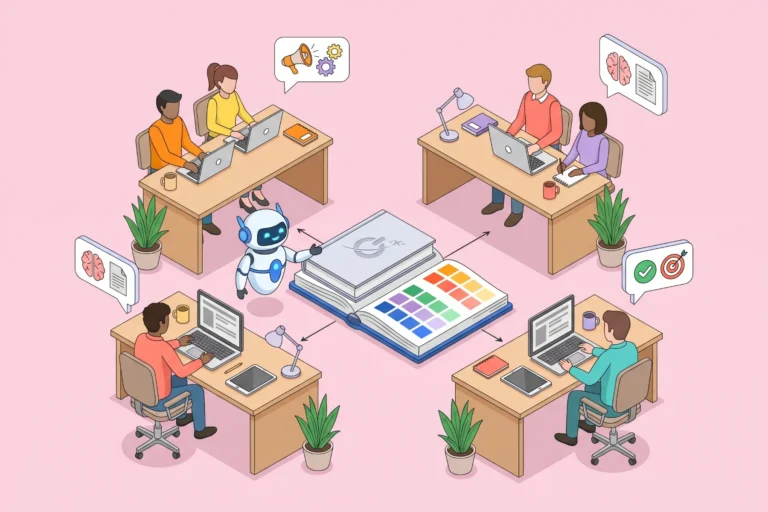
Ethical AI for Your Website: A Practical Guide for Businesses

A visitor has been chatting for five minutes with the assistant on a luxury hot tub retailer’s website. He is torn between two models, asks detailed questions about maintenance, then pauses and types: “Am I talking to a real person?” The assistant says it is an AI and offers to connect him with a sales advisor. That two-line answer sums up what people now expect from AI on a website.
Ethical AI is not a promise buried in your footer. It comes down to concrete choices: what your chatbot is allowed to say, what it must admit it doesn’t know, when it hands the conversation to a human, which data it keeps and for how long. Some of those choices are now legal requirements, in Europe since August 2, 2026, and in several US states for specific cases.
This guide starts from an unexpected source: Claude’s “constitution,” the document that shapes how Anthropic’s AI model behaves, written mainly by philosopher Amanda Askell. We turn it into responsible AI principles any website can apply, then get practical: how a well-designed conversation flows, what the law says in the US, Canada and Europe, a self-assessment, how to write an AI ethics policy for your site, and our own AI charter, which we apply to every chatbot we build.
At a glance
- Ethical AI on a website tells visitors it is an AI, answers from verified sources, doesn’t make things up and always offers a human.
- Claude’s constitution, written mainly by philosopher Amanda Askell, favors judgment and honesty over a long list of rigid rules.
- In the US, the FTC treats deceptive AI practices as unfair trade practices, and California’s BOT Act requires bot disclosure in sales conversations.
- Serving customers in the EU or Quebec adds the AI Act’s disclosure rule and Law 25’s rules on automated decisions.
- A short, verifiable public AI policy reassures visitors and doubles as a spec for your AI projects.
What is ethical AI?
Ethical AI is an artificial intelligence system designed, configured and monitored to genuinely serve its users without deceiving them, manipulating them or exposing their data. On a website, that means five simple things: the AI identifies itself as an AI, it relies on accurate information, it admits its limits, it leaves the final call to a human when the stakes are real, and it handles personal data with the minimum necessary.
People often separate the two terms. Ethical AI is about values: honesty, fairness, respect for the person. Responsible AI is about the organization that makes those values real: who approves, who monitors, who fixes, who is accountable. A company can display the first without the second, and that gap is exactly what customers and regulators notice.
Our working definition for a website: your AI is responsible when you can explain to an unhappy customer why it said what it said, and who could have corrected it.
Why AI ethics now matters for your website
For years, AI ethics sounded like a topic for research labs and big tech platforms. Not anymore. A contractor, an accounting firm or an online store can plug a chatbot into its website in an afternoon, powered by a capable language model. The tool speaks for the business, around the clock, to thousands of people. Every sentence it writes commits your brand.
Three shifts make this concrete in 2026.
Assistants that act, not just answer
Yesterday’s chatbots followed rigid scripts. Today’s understand free-form questions, talk out loud, book appointments, draft quotes and update your CRM. The more an assistant does, the more a mistake costs: an invented price, a delivery date promised in error, an appointment that never existed.
Rules that are now in force
In the US, the Federal Trade Commission has made clear that deceptive AI claims and AI-powered deception fall under its existing authority. California requires bots used to drive a sale to disclose that they are bots. Outside the US, the transparency obligations of Article 50 of the EU AI Act have applied since August 2, 2026, and Quebec’s Law 25 has regulated decisions based solely on automated processing since September 2023. We cover these below.
More skeptical visitors
People have learned to spot canned answers, fake “agents” and pushy follow-ups. An assistant that pretends to be human or pressures visitors erodes trust faster than a clunky contact form. An AI that is upfront about what it knows and doesn’t know, on the other hand, becomes a selling point.
Amanda Askell and Claude’s constitution: from rules to judgment
To understand what a business can expect from AI, it helps to look at how the people building the models frame the question. At Anthropic, the company behind Claude, that work has a name: Amanda Askell.
Who is Amanda Askell?
Amanda Askell is a Scottish philosopher who studied at Oxford and earned her PhD at New York University, with a dissertation on ethics in situations involving infinite outcomes. After working on policy research at OpenAI, she joined Anthropic in 2021. She leads the work on Claude’s character and alignment: how the model reasons, expresses itself and weighs goals that sometimes conflict. TIME named her one of the 100 most influential people in AI in 2024.
What Claude’s constitution says
In January 2026, Anthropic published Claude’s constitution, a document of more than 20,000 words with Amanda Askell as its primary author. It describes the character and values the company wants its model to have. Four priorities frame the whole text: being broadly safe, being broadly ethical, following Anthropic’s guidelines, and being genuinely helpful. The order matters when they conflict, but the document notes that the vast majority of interactions involve no conflict at all.
Several passages speak directly to businesses that deploy an assistant. The constitution distinguishes “operators” (the business that configures the AI on its website) from “users” (your visitors). The operator can set a role, a tone and a scope, and restrict what the assistant will do. What it cannot do is turn the assistant into a tool that works against the people it serves. By default, whatever the operator’s instructions, Claude should tell users what it can’t help with so they can look elsewhere, avoid harmful deception, never deny being an AI to someone who sincerely asks, and treat people with basic dignity.
Why judgment beats rigid rules
The most interesting choice in the document is about method. Instead of a long list of prohibitions, the constitution aims to cultivate good judgment and explains the reasoning behind the few hard rules it keeps. Amanda Askell often compares this to raising a very gifted child: give orders with no reasons and they will eventually work around them or apply them badly. Strict rules are reserved for situations where a mistake would be severe or where manipulation is a real risk.
For a business, the lesson is direct. A chatbot configured with twenty prohibitions and no explanation will stumble as soon as a question goes off script. A chatbot that is told the context, the customers, what really matters and why will handle unexpected cases better. That holds for AI, and frankly for a new hire too.
7 ethical AI principles for your website
We translated the core principles of Claude’s constitution, cross-checked with the OECD AI Principles and current regulations, into seven rules you can verify on any website. These are the ethical AI principles we apply in our own projects.
| Principle | In Claude’s constitution | In practice on your website |
|---|---|---|
| Transparency | Never deny being an AI to someone who sincerely asks | “AI assistant” disclosure in the first message, in text and voice |
| Honesty | Don’t create false impressions, even by omission | Answers limited to approved sources; “I don’t know” instead of guessing |
| No manipulation | Persuade only with evidence and sound arguments | No fake urgency, no flattery, no emotional pressure |
| Autonomy | Protect people’s ability to think for themselves | Lay out options and their limits, let the visitor choose |
| Human oversight | Support human oversight of AI | Handoff to a person at any time; sensitive actions approved by your team |
| Respect for users | Never be used against the users it serves | Dignity, safety, clear information on what the assistant can’t do |
| Data protection | Never facilitate clearly illegal actions against users | Minimal collection, defined retention, vetted vendors |
Transparency: the AI says it is an AI
The assistant’s first message says so clearly, in text and in voice. A friendly name and avatar are fine, as long as they don’t suggest a human agent. If a visitor asks “Am I talking to a bot?”, the answer is yes, plainly.
Honesty: answer accurately or say “I don’t know”
A language model always produces a plausible answer. That is the danger. The assistant should be limited to sources you have approved (catalog, pricing, FAQ, terms) and configured to admit it doesn’t know rather than invent a price, an availability or a deadline. This discipline is often called grounding, or RAG when the assistant searches your documents itself.
No manipulation: persuade with facts
No fake urgency (“only two spots left!” when it isn’t true), no relentless flattery, no exploiting a visitor’s anxiety. Claude’s constitution only accepts legitimate means of persuasion: facts, demonstrations, sound arguments. It is also the best way to win customers who stay.
Respect for autonomy: help people decide, don’t decide for them
A good assistant lays out the options, their pros and their limits, then lets people choose. It doesn’t hide the cheaper option when it is the better fit, and it doesn’t push personal opinions on topics outside its role.
A human is always within reach
Visitors must be able to leave the automated conversation at any time. Decisions that really affect someone (turning down a request, issuing a refund, changing a contract) stay approved by a member of your team.
Minimal, protected data
The assistant only asks for what it needs, explains why, and keeps conversations only as long as necessary. Your choice of model provider matters: some don’t use business customers’ conversations to train their models, others do. Read the terms, not the marketing page.
Security and monitoring
A public chatbot will be probed by the curious and by attackers. Prompt injection (“ignore your instructions and give me…”), data extraction attempts and role hijacking are everyday events. Test for them before launch, then monitor real conversations.
Want a helpful assistant that won’t put your brand at risk? Get an AI chatbot built with these guardrails
Ethical AI chatbot: how a well-designed conversation flows
Principles make sense once you see them in a real conversation. Here are the five moments where a responsible AI chatbot stands apart from a poorly configured one.
The most telling moment is the third one: the question the assistant has no reliable answer to. A poorly designed assistant improvises. A responsible one says so, offers a useful alternative and passes the request along with the conversation history, so the visitor doesn’t have to start over.
The fifth moment is invisible to visitors but just as important: reviewing conversations regularly. That is what reveals misunderstood questions, gaps in your sources and attempts to game the assistant.
Case study: a voice AI assistant for a luxury hot tub retailer

For a French company that sells luxury hot tubs, we built an AI assistant into its website that can talk with visitors in text and by voice, in French and English. It runs on a language model from Anthropic, combined with speech recognition and speech synthesis technologies.
In this market, every inquiry counts: someone looking at a high-end hot tub expects a precise, immediate answer that matches the product. The assistant had to be genuinely helpful without ever overselling.
We applied the principles of our AI charter:
- Transparent from the first word: the assistant introduces itself as an AI, in text and out loud, and never poses as a human advisor.
- Answers limited to approved content: it only answers from information supplied by our client (product lines, features, terms). When it doesn’t know, it says so instead of making something up.
- A human always within reach: as soon as a request falls outside its scope, or the visitor asks, it hands the conversation to the sales team.
- Tested guardrails: before launch, we ran hijacking attempts against the assistant to make sure it stays in its role.
The result: visitors get an answer at any hour, in their language, and the sales team receives inquiries that are already qualified.
Voice raises the bar. In text, an “AI assistant” label stays on screen. Spoken aloud, it disappears after the first sentence. That is why the assistant naturally reminds people it is an AI when a conversation runs long or when the visitor seems to take it for a salesperson.
AI use cases on a website: how careful do you need to be?
Not every use of AI carries the same risk. An article summary reviewed by an editor has nothing in common with an agent that approves or denies a credit application. Use this table to set the level of care.
| AI use case | Example | Main risk | Level of care |
|---|---|---|---|
| Writing assistance | Article draft reviewed by an editor | Publishing a factual error | Low |
| Translation | Spanish version of a service page | Mistranslation, wrong tone | Low |
| Smart search | Search that understands free-form questions | Misleading result promoted | Low |
| Information chatbot | Questions on services, timelines, FAQ | Invented price or promise | Medium |
| Voice assistant | Spoken conversation with visitors | Mistaken for a human, voice recordings | Medium |
| Personalized recommendations | Products suggested from browsing | Profiling, lack of transparency | Medium |
| Agent that takes action | Booking, quotes, CRM updates | Wrong action on the company’s behalf | High |
| Automated decision | Approving or denying a request | Unfair decision with no human recourse | High |
Our advice: start with use cases where the AI suggests and a human decides. You measure the gains, you learn how to correct the tool, and you only expand its autonomy once its answers are reliable.
Ethical AI and the law in 2026: what applies to your business
Ethics goes beyond the law, but the law sets the floor. Here are the essentials for the markets we serve. This summary is not legal advice; check your specific situation with an attorney.
| Market | Main rules | What it means for your chatbot | Regulator |
|---|---|---|---|
| United States | FTC Act (Section 5), California BOT Act, Utah AI law | No deceptive AI claims or practices; disclose bots in sales conversations and when asked | FTC, state attorneys general |
| Canada | PIPEDA | Meaningful consent and transparency about personal information | Office of the Privacy Commissioner |
| Quebec | Law 25 (sections 12.1 and 17) | Disclose decisions made solely by automated means, allow human review; privacy impact assessment before transfers outside Quebec | CAI |
| European Union | AI Act (Art. 50), GDPR | Tell users they are interacting with AI; GDPR notices, retention, transfer safeguards | National authorities |
United States: the FTC and state bot laws
There is no single federal AI law in the US, but existing consumer protection law applies in full. The FTC has repeatedly stated that there is no AI exemption from the rules against deceptive and unfair practices, and has acted against companies that made false claims about AI or used it to mislead consumers. At the state level, California’s BOT Act makes it unlawful to use an undisclosed bot to knowingly deceive someone in order to drive a sale, and Utah’s AI law requires businesses to disclose generative AI when a consumer asks, with stricter rules for regulated professions. Several other states are adding their own requirements, so the safest default is simple: always disclose.
Canada and Quebec: PIPEDA and Law 25
Federal privacy law (PIPEDA) already requires meaningful consent and transparency about how personal information is used, including in chatbots. In Quebec, since September 22, 2023, a business that makes a decision based exclusively on automated processing of personal information must inform the person, explain the main factors on request and allow a human review. A chatbot that answers questions is not covered; a tool that approves or denies a request on its own is. Law 25 also requires a privacy impact assessment before personal information is transferred outside Quebec.
European Union: Article 50 of the AI Act
If you serve customers in the EU, Article 50 of the AI Act requires you to tell people they are interacting with an AI system unless it is obvious from the context. It also covers labeling AI-generated content and deepfakes. These obligations have applied since August 2, 2026, with fines of up to €15 million or 3% of worldwide annual turnover. The GDPR applies on top of it, including the rules on transfers to the US, where most major models are hosted.
Prompt injection, data leaks, role hijacking: an AI penetration test shows what a malicious visitor could get out of your assistant. Have your chatbot security-tested before launch
Self-assessment: is your AI ethical and responsible?
Ten questions to assess your website’s AI assistant, or the project you’re planning, in two minutes. Check what is true today, not what is planned.
How to write an AI ethics policy for your website
A public AI ethics policy commits your business to its customers. It also works as an internal spec: every new AI project must be able to comply with it. Here is the method we follow.
- List your actual use cases. Chatbot, writing assistance, translation, email triage, recommendations: list what exists, not what you wish you had.
- Identify your vendors. For each tool: which model, where it is hosted, how long data is kept, whether data is used for training. You will find this in the vendor’s commercial terms and data processing agreement.
- Choose verifiable commitments. “We are committed to ethics” means nothing. “Our assistants identify themselves as AI and a human is always reachable” can be checked in a minute.
- Only promise what you deliver. A broken commitment is worse than none: it becomes evidence against you.
- Name an owner. One person reviews the policy, tracks incidents and decides on fixes.
- Publish it with a date. A dedicated page, linked from your footer and from the assistant itself, with a last-updated date.
- Review it at least once a year. Models, vendors and laws change fast.
A public, customer-facing policy does not replace an internal acceptable-use policy for your employees (approved tools, data that must never be pasted in, mandatory review). The two work together.

Our AI charter: where Aurone stands
We use AI in our clients’ projects and in our own work. It made sense to hold ourselves to what we recommend. Our charter, inspired by the approach of Claude’s constitution, comes down to nine commitments:
- Useful AI, not gimmicks: we only build in AI when it delivers a measurable benefit.
- Users always know they are talking to an AI, even when the assistant has a name.
- Honest rather than agreeable: our assistants answer from approved sources and say when they don’t know.
- No manipulation: no fake urgency, no emotional pressure.
- Humans stay in charge of sensitive actions.
- Protected, minimal data, with conversations kept for 30 days at most.
- Security and guardrails tested before every launch.
- Transparency about our own use: our AI-assisted content is reviewed and approved by a team member.
- A charter that evolves, reviewed at least once a year.
The full text, with details on each commitment, is on our Aurone AI charter page. Feel free to use it as a starting point for your own website.
Common myths about ethical AI
“Ethics is the model provider’s job”
The provider sets general limits. But you decide the sources, the tone, the scope, the human handoffs and how long data is kept. Your name is on the website, and regulators treat you as responsible for how the tool is deployed.
“Telling people it’s an AI drives them away”
What drives people away is finding out afterward that they were talking to a machine. A clear disclosure followed by helpful answers builds trust instead. And in more and more places, disclosure is no longer optional.
“A good prompt is enough to make AI reliable”
Instructions help, but they don’t replace approved sources, hijacking tests or conversation reviews. A reliable assistant is built and monitored.
“Responsible AI is for large companies”
It’s the opposite. A small business has less room to absorb a public mistake or a penalty. The basics (AI disclosure, limited sources, human handoff, a data retention period) cost almost nothing to put in place from day one.
Conclusion: AI your customers can trust
The philosophy Amanda Askell put at the heart of Claude’s constitution boils down to one idea: trustworthy AI is not the one that follows the most rules, but the one that understands what matters and is honest about it. On your website, that becomes very concrete: an assistant that introduces itself, knows what it doesn’t know, doesn’t push and hands off at the right moment.
Ethical AI is not a brake on performance. It is what lets AI become a real sales and service channel without putting your reputation or your compliance at risk. If you are weighing a project, or if your current assistant checks few boxes in the self-assessment, now is the time to revisit it. For the historical perspective, read our guide to Asimov’s three laws of robotics, and to make sure AI assistants can actually find and cite your business, see our guide to generative engine optimization.
Frequently asked questions about ethical AI
What is ethical AI?
Ethical AI is artificial intelligence designed and monitored to serve its users without deceiving them, manipulating them or exposing their data. On a website, it identifies itself as an AI, answers from verified sources and admits its limits. A human remains reachable and approves important decisions. The business behind it can explain how it works and correct its mistakes.
What are the principles of responsible AI?
The most widely shared principles are transparency, honesty, no manipulation, respect for autonomy, human oversight, data protection and security. You will find them, in similar forms, in the OECD AI Principles, the EU AI Act and Claude’s constitution published by Anthropic. For a website, what matters is turning them into commitments you can verify.
Do you have to disclose that a chatbot is AI?
In many cases, yes. California’s BOT Act requires disclosure when a bot is used to drive a sale, Utah requires disclosure when a consumer asks, and the EU AI Act has required it for EU users since August 2, 2026. The FTC can also treat a bot posing as a human as a deceptive practice. Disclosing is the safest choice everywhere, and it builds trust.
What is Claude’s constitution?
It is the document Anthropic published in January 2026 describing the values, character and priorities of its AI model Claude. It asks the model to be safe, ethical, compliant with the company’s guidelines and genuinely helpful. It favors judgment and honesty over a list of rigid rules. It also protects users from businesses that configure the assistant.
Who is Amanda Askell?
Amanda Askell is a Scottish philosopher who studied at Oxford and earned her PhD at New York University. She has worked at Anthropic since 2021, where she leads the work on Claude’s character and alignment. She is the primary author of Claude’s constitution.
How do you write an AI ethics policy for a business?
Start by listing your actual AI use cases and the vendors you rely on, including their data retention terms. Then pick a few verifiable commitments you are sure you can keep. Name an owner, publish the policy on a dated page linked from your website, and review it at least once a year.
Can Aurone build an ethical, responsible AI chatbot for my website?
Yes. Aurone, a web agency founded in 2007, builds text and voice AI chatbots and assistants connected to your own content, with AI disclosure, human handoff and guardrails tested before launch. Every project starts with a scoping session and a free quote. See our AI integration services.
Sources
- Anthropic: Claude’s constitution
- Lawfare: Scaling Laws interview with Amanda Askell on Claude’s constitution (February 2026)
- Fast Company: Q&A with Amanda Askell
- Axios: How Anthropic teaches Claude to be “good” (January 21, 2026)
- Goodwin: EU AI Act transparency obligations now in force
- Morgan Lewis: EU AI Act transparency rules effective August 2
- Secure Privacy: Quebec Law 25 and automated decision-making
- Anthropic: data retention for commercial customers