WordPress Freelancer, Developer or Agency: How to Choose

Choosing between a freelance WordPress developer, an in-house WordPress developer, or an agency isn’t just about price. The right choice depends on what’s at stake, the post-launch workload, and the level of risk you are willing to place on a single person. This guide compares the three models using concrete criteria, provides 2026 market rates, explains where to find a freelance WordPress developer and how to vet their skills, and lists the questions to ask and clauses to demand before signing. A diagnostic tool will help you decide based on your project.
At a glance
- A freelance WordPress developer is ideal for projects with a clear scope, a tight budget, and low continuity stakes.
- An in-house WordPress developer makes sense when the site requires daily work and deep knowledge of the company.
- A WordPress agency provides a complete team (design, development, SEO, security, maintenance) and service continuity.
- The daily rate for a freelance WordPress developer ranges from about $200 for a junior to over $600 for an expert.
- Before signing, check references, methodology, maintenance plans, and site ownership, regardless of the provider.
Freelance WordPress Developer: Definition and Role
A freelance WordPress developer is an independent professional who builds, modifies, or maintains WordPress websites for multiple clients under their own business structure (sole proprietorship, LLC, independent contractor). They charge by the project or by the day, have no subordinate relationship with their clients, and usually work alone or with a few partners.
Behind this title lie very different profiles. Some build brochure sites using a theme and a page builder, others develop custom themes and plugins in PHP and JavaScript, while others focus on maintenance, speed, or SEO. Before comparing prices, you need to know what kind of skills your project requires.
The stakes are high, especially since WordPress powers 39.3% of all websites and 58% of sites with a known CMS, according to W3Techs (November 2026). The provider market is huge, and quality varies wildly.
WordPress Freelancer vs Agency or In-House Developer: The Three Models
There are three ways to organize a WordPress website project. They aren’t always mutually exclusive: many companies combine an agency for the build and a freelancer for minor tweaks, or an in-house employee backed by an agency for security.
The Freelance WordPress Developer
A freelancer offers direct contact with the person writing the code, great flexibility, and rates often lower than an agency. It’s a solid choice for a brochure site, a landing page, a specific plugin, or a batch of fixes. The limitation is availability: if they are sick, on vacation, or swamped by another client, your project stalls. Rarely does one person master design, development, SEO, and security all at once.
The In-House WordPress Developer
Hiring an in-house developer makes sense when the website is the core of your business and requires daily work: an e-commerce store with constant updates, a custom platform, or integrations with an ERP or CRM. They know your products, your teams, and your priorities. On the flip side, it’s a high fixed cost, recruiting is demanding, and one person can hardly cover every skill. We detail this choice in our article on outsourcing vs. hiring a developer.
The WordPress Agency
An agency brings together multiple professions: project manager, designer, developers, SEO specialists, and security experts. It ensures continuity (a backup if someone is absent), a proven methodology, and post-launch support. It costs more than a freelancer for a small project, and communication might be less direct if the agency is large or secretly outsources. For a site that generates revenue, it’s often the safest option: this is the model of our WordPress agency.

Comparison: Freelance, In-House Developer, or WordPress Agency
The table below compares the three models based on criteria that truly matter for a professional website. These are general trends: an excellent freelancer can outperform a mediocre agency.
| Criterion | Freelance WordPress Developer | In-House Developer | WordPress Agency |
|---|---|---|---|
| Initial cost | Lowest for a small project | High (salary, taxes, recruitment) | Higher than a freelancer, predictable flat rate |
| Skills covered | Often a single specialty | One person, needs supplementing | Design, development, SEO, security, maintenance |
| Availability | Variable, depends on one person | Daily, except for PTO and turnover | Team, backup in case of absence |
| Company knowledge | Limited to the project scope | The best | Good with a dedicated account manager |
| Methodology and documentation | Highly variable | Depends on the individual | Formalized processes, generally |
| Dependency risk | High if the freelancer disappears | High if the employee leaves | Low if accounts are in your name |
| Suitable projects | Brochure site, tweaks, specific plugin | Core business site, continuous updates | E-commerce, redesign, strategic site, ongoing maintenance |
How Much Does a Freelance WordPress Developer Cost in 2026?
A freelance WordPress developer usually charges an average daily rate, or a flat fee for a well-defined project. Amounts vary widely based on experience, specialty, and location. The following figures are standard market rates; in countries like Switzerland or the US, rates can be significantly higher, while in others they align closely when converted, with stark differences between major cities.
The Daily Rate of a Freelance WordPress Developer
Simulators published in 2026 place the daily rate of a freelance WordPress developer around $200 to $300 for a junior profile, $300 to $450 for a mid-level professional, and $450 to $600 for an expert (Travail Industrie). La Fabrique du Net, relying on the Malt barometer, notes a range of $317 to $672 per day for WordPress freelancers and observes posted rates of $400 to $600 on Malt (La Fabrique du Net).
On low-cost matchmaking platforms, rates drop much lower: on Codeur.com, a large portion of WordPress developers list between $70 and $210 per day (Codeur.com). These gaps reflect very different experience levels, countries, and mission types: a low daily rate is only a good deal if the work is actually delivered, documented, and maintainable.
WordPress Website Budget by Provider
For a professional brochure site, La Fabrique du Net observes 2026 budgets of $1,500 to $5,000 with a freelancer, and $5,000 to $15,000 or more with an agency for an e-commerce or custom site, plus $500 to $2,000 per year for maintenance (La Fabrique du Net). To understand what drives a quote up or down, read our guide on how to price a website.
The True Cost of an In-House Developer
A mid-level web developer earns around $42,000 gross per year, ranging from $35,000 for a junior to $57,000 for a senior according to 2026 salary grids (Salerya). You must add employer taxes, workspace, software, training, and recruitment time. This cost is only justified if the website truly requires a full-time position year-round.
Flat Rate, Time and Materials, or Retainer
A flat rate sets a price for a specific scope: ideal for a well-defined brochure site. Time and materials billing charges for the hours spent: suitable for continuous updates, provided you track the hours. A retainer covers maintenance and a set volume of monthly tasks. We compare these models in our article on flat rate, time and materials, or retainer.
Developer, Integrator, WordPress Expert: Who Does What?
Titles overlap and everyone uses them differently. When reading a quote or a profile, focus on what the person actually knows how to do.
- WordPress Integrator or Webmaster: Installs a theme, configures plugins, layouts content using a page builder. Little to no custom code.
- WordPress Developer: Writes code (child theme or custom theme, plugins, Gutenberg blocks, API integrations) in PHP, JavaScript, HTML, and CSS. For complex custom needs, you can explore our WordPress development services.
- WordPress Expert: An experienced developer who also masters performance, security, migrations, and the architecture of complex sites (WooCommerce, multisite, high traffic).
- WordPress Consultant: Advises on plugin choices, architecture, SEO, or taking over an existing site, without necessarily writing code.
Skills to Verify
Regardless of the title, verify their mastery of PHP and JavaScript, WordPress best practices (hooks, child themes, blocks), security (updates, permissions, backups), performance (caching, images, Core Web Vitals), and technical SEO basics. For a store, add WooCommerce, online payments, and e-commerce legal requirements. A good provider also knows how to explain what they do and why in plain English.
Where to Find a Freelance WordPress Developer?
Not all channels are equal, and the most visible isn’t always the best.
- Specialized Platforms: Malt, Codeur.com, or international platforms like Fiverr and Upwork. They provide access to many profiles and reviews, but reviews often reflect small, simple tasks.
- WordPress Community: WordCamp events and local meetups gather active developers who sometimes contribute to WordPress core or popular plugins.
- Recommendations: A satisfied peer, your web host, or your accountant can point you toward reliable professionals.
- Agencies: Some agencies offer one-off interventions or monthly maintenance, providing the continuity of a team.
On a platform, read recent reviews, look at the nature of the projects (a brochure site is not a 2,000-product store), and open the referenced websites. Slow, broken, or missing sites speak volumes.
Working with a Remote Freelance WordPress Developer
You don’t have to choose a local provider: most WordPress projects are handled entirely remotely, with video calls and written exchanges. What matters is the working language, the time zone, and the clarity of commitments. A freelancer based in another country might offer a lower rate, but ensure they can issue a compliant invoice, that the contract specifies the applicable law, and that your data remains protected according to your local regulations (like GDPR or CCPA).
Time zone differences aren’t necessarily a problem: they can even allow for updates to happen at night when traffic is low. It becomes an issue if no one answers during your business hours while your store is down. Always ask for their availability windows and guaranteed response times for emergencies.
Choosing Based on Your Project
The right provider depends primarily on what’s at stake for your website. Answer the five questions in the tool below to get an initial recommendation, then read the typical scenarios.

Simple Brochure Site, Limited Budget
For a site with a few pages and no special features, an experienced freelance WordPress developer often provides the best value. Demand a reputable theme or clean custom code, a reasonable number of plugins, admin training, and a backup solution.
WooCommerce Store or Strategic Site
When a site generates sales or quote requests, downtime or a security breach is costly. You need to combine development, payments, security, performance, and SEO, while having a reliable backup person. An agency is more suitable here, much like our WooCommerce agency for online stores. Once the store is live, our guide on how to increase online sales shows where to start.
Redesign with SEO Stakes
A poorly planned redesign can wipe out a massive chunk of organic traffic: changed URLs without redirects, deleted content, forgotten meta tags. Choose a provider capable of delivering a redirect map and a before/after SEO audit, or bring in a WordPress SEO specialist. Our progressive redesign methodology minimizes these risks.
Existing Site to Maintain
For a site already live, consistency is key: tested updates, off-site backups, and monitoring for security and performance. A freelancer can handle this if they commit to it in writing; an agency’s WordPress maintenance plan (or our dedicated website maintenance plans) additionally provides guaranteed response times.
How to Vet a Freelance WordPress Developer: The 7-Step Method
An attractive profile isn’t enough. This method allows you to objectively compare several WordPress freelancers, or a freelancer and an agency.
To go further, our grid for evaluating a web provider details the criteria to score, and our guide on preparing a website quote request helps you get comparable proposals.
Questions to Ask Before Signing
These questions apply whether you are hiring a freelance WordPress developer or an agency. Vague answers are a red flag in themselves.
- Who will actually work on my site, and who covers for them if they are absent?
- Will the site be built with a commercial theme, a page builder, or a custom theme, and why?
- Which plugins do you plan to use, and who pays for their annual licenses?
- How do you test updates before applying them to the live site?
- Where are backups stored, and how often are they taken?
- Will the domain name, hosting, and accounts (Google Analytics, Search Console) be registered in my name?
- What is included after launch, and at what rate are additional tasks billed?
- How is SEO handled: structure, speed, meta tags, redirects in case of a redesign?
Contract, Ownership, and Access: Protecting Your Website
This is the most frequently overlooked point, and the one that costs the most in case of a split. A WordPress site relies on a domain name, hosting, code (theme, custom plugins), content, and third-party accounts. If these elements are under the provider’s name, switching freelancers or agencies becomes a nightmare.
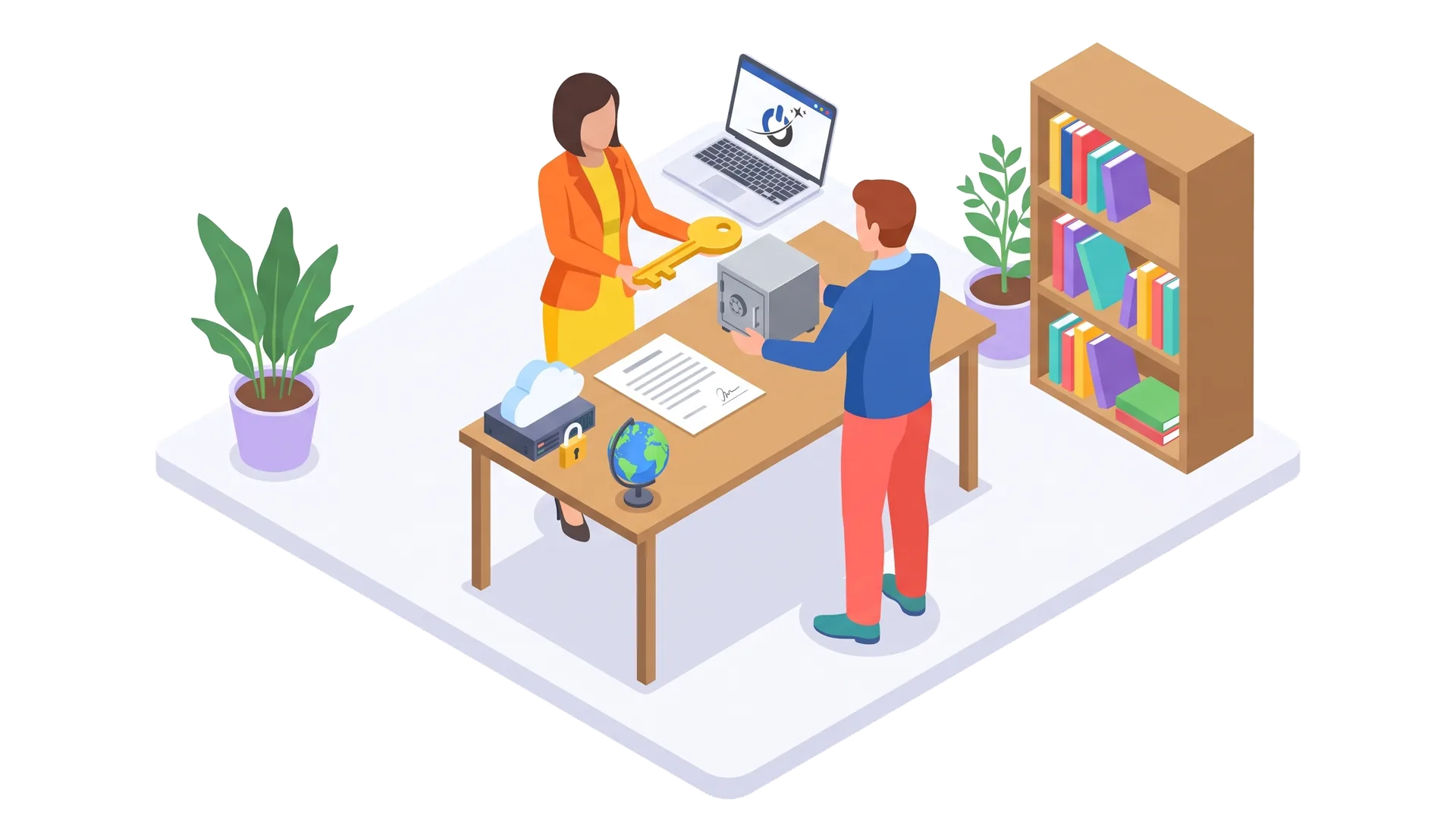
Demand in writing that the domain name and hosting are registered in your name, with your own credentials, and that you have full administrator access to the site. The contract must specify the transfer of rights for the code and graphic assets developed for you, as well as reversibility conditions: handover of files, database, and documentation at the end of the contract. We detail these points in our article on who really owns your website, and copyright issues in our guide on website intellectual property.
The legal framework varies by country: copyright law in the US and UK, the Copyright Act in Canada, or specific intellectual property laws in Europe. Regardless, what isn’t written down is hard to claim. If your personal data passes through the provider (forms, e-commerce customers), also include data protection clauses required by GDPR, CCPA, or Quebec’s Law 25.
Red Flags You Shouldn’t Ignore
Certain signals should make you pause before signing, whether dealing with a freelancer or an agency.
- A very low quote with no details, or the promise of a complete site in a few days.
- Refusal to put the domain name or hosting in your name.
- No verifiable references, or reference sites that are slow, broken, or offline.
- A dozen plugins announced for simple features, or “free” premium themes downloaded outside the official repository.
- No backup solution or update plan after launch.
- Difficult communication from the first exchange: late replies, heavy jargon, promises of a #1 ranking on Google.
Our guide on choosing a web design agency completes this list for larger projects.
After Launch: Maintenance, Security, and Continuity
A WordPress site is never truly finished. The core, theme, and plugins receive updates weekly, often to patch security vulnerabilities. Without ongoing support, a site becomes vulnerable in a matter of months, and abandoned plugins pile up.
This is where the difference between the models is most apparent. A freelancer can handle maintenance if they formally commit to it, with guaranteed response times and off-site backups. But if they change careers, you have to find someone else capable of taking over a site they didn’t build. An agency guarantees continuity through its team, and an in-house employee covers daily needs as long as they stay with the company.
Collaborating Effectively Day-to-Day
A good relationship with a WordPress developer often comes down to a few simple habits. Group your requests in a single tool (a shared board, a task manager, or a single message thread) rather than scattering them across emails, calls, and instant messaging. Describe each request with the page URL, a screenshot, and the expected result. Set priorities: something blocking sales comes before a button color change.
Also, ask for a demo or a staging environment review before any major live update, and approve it in writing. This tracking prevents misunderstandings, protects both parties in case of a dispute, and makes handing over the site much easier if you ever change providers.
Whatever your choice, secure a written web maintenance contract, basic site documentation (plugins, settings, access), and backups you can restore without the provider. In the event of a hack, a quick response makes all the difference: our team also offers WordPress security services.
Misconceptions About WordPress Freelancers and Agencies
“A freelancer is always cheaper”
On the initial quote, often yes. Over time, not necessarily: a poorly built site costs a lot in bug fixes, slow performance, and security breaches, and a freelancer who vanishes forces you to pay someone else to take over the site.
“An agency outsources everything”
Some do, others have their own in-house teams. Ask the question directly: who is developing, where are they located, and who is your point of contact? A clear answer is a good sign.
“WordPress is easy, anyone can do it”
Installing WordPress is easy. Building a fast, secure, SEO-friendly, and scalable site requires real skills, and that is exactly what separates a WordPress expert from a theme installer.
“An in-house employee will always be more available”
For daily tasks, yes. But they take vacations, might leave the company, and don’t always master security or design. Many companies supplement an internal role with an agency.
Does AI Change How You Choose a WordPress Provider?
Coding assistants generate PHP snippets, blocks, or styles in seconds, and some site builders offer entire pages generated by AI. This speeds up the workflow for good WordPress developers, but it replaces neither requirements analysis, code review, nor security checks. Unverified generated code can introduce vulnerabilities or incompatibilities that are hard to detect.
So, ask the provider: how do they use AI, and how do they review what it produces? A serious professional uses it as a tool, takes responsibility for the result, and can explain every line delivered. Furthermore, how your site will be read by AI answer engines like ChatGPT is becoming a selection criterion: this is the focus of our AI SEO offering.
Conclusion
A freelance WordPress developer is an excellent choice for a well-defined project with a tight budget and low continuity stakes, provided you vet their references and retain control of your site. An in-house WordPress developer makes sense when the site truly requires a full-time role year-round. For an online store, a redesign, or a site that drives your revenue, a WordPress agency provides the combination of skills and continuity that minimizes risks.
Our advice: make your choice based on what is at stake for your website, not the price of the first quote. And regardless of the provider, demand accounts in your name, a clear contract, and a written maintenance plan. If you are debating a PrestaShop project, our comparison on PrestaShop expert, freelancer, or agency uses the same evaluation framework.
Frequently Asked Questions About Choosing a Freelance WordPress Developer
Is it better to hire a freelance WordPress developer or an agency?
It depends on what is at stake for the site. A freelance WordPress developer is suitable for a brochure site or a targeted task with a limited budget. An agency is better for an online store, a redesign, or a strategic site because it combines multiple skills and ensures continuity if someone is absent. In both cases, check references and demand admin access in your name.
What are the rates for a freelance WordPress developer?
In the US and Europe, the daily rate for a freelance WordPress developer ranges from about $200 to $300 for a junior to $450 to $600 for an expert, according to 2026 market data. Low-cost platforms show much lower rates. For a professional brochure site, expect to pay generally $1,500 to $5,000 with a freelancer, excluding maintenance.
How do I find a good WordPress developer?
Use recognized platforms like Upwork or Malt, tap into the WordPress community (WordCamps, meetups), or rely on recommendations. Review three reference sites, call a past client, and offer a small paid task before committing. A good developer clearly explains their methodology, testing, and update management.
What is a WordPress expert?
A WordPress expert is an experienced developer who, in addition to building custom themes and plugins, masters performance, security, migrations, and the architecture of complex sites like WooCommerce stores. They know how to take over an existing site, diagnose slow speeds or hacks, and advise on the right technical choices.
Do I need a maintenance contract for a WordPress site?
Yes, for any professional website. WordPress, its themes, and plugins receive frequent updates, often for security, which must be tested before being applied. A maintenance contract details updates, backups, monitoring, and response times, whether the provider is a freelancer or an agency.
Can AI replace a WordPress developer?
No. AI speeds up writing code and creating pages, but it replaces neither requirements analysis, code review, nor security. Code generated without oversight can introduce vulnerabilities. A WordPress developer uses AI as a tool and remains responsible for the quality of the delivered site.
Our Sources
- W3Techs, usage statistics of WordPress (November 2026)
- La Fabrique du Net, freelance WordPress developer: rates and advice (2026)
- La Fabrique du Net, how much does a WordPress site cost in 2026
- Codeur.com, average rate of WordPress developers
- Travail Industrie, WordPress developer daily rate simulator (2026)
- Salerya, web developer salary in 2026