Asimov’s 3 Laws of Robotics: What They Say and What They Mean for AI
This guide explains what the 3 laws of robotics say, where they come from, what the zeroth law adds, and why Asimov’s laws are not enough to govern today’s AI. It also shows which rules actually apply in 2026 (the EU AI Act, OECD principles, the UNESCO recommendation, the Council of Europe convention) and what they mean for a business using AI on its website or in its tools.
At a glance
- The 3 laws of robotics, devised by Isaac Asimov in 1942, forbid a robot to harm a human and require it to obey and protect itself, in that order of priority.
- Asimov later added a zeroth law: protect humanity as a whole.
- These laws are fiction: no country or AI company has adopted them as such, and his own stories expose their flaws.
- Today’s AI is governed by other texts, including the EU AI Act, phased in from 2025 to 2028.
- For a business, the real issues are transparency, data protection and human oversight.
What do the 3 laws of robotics say?
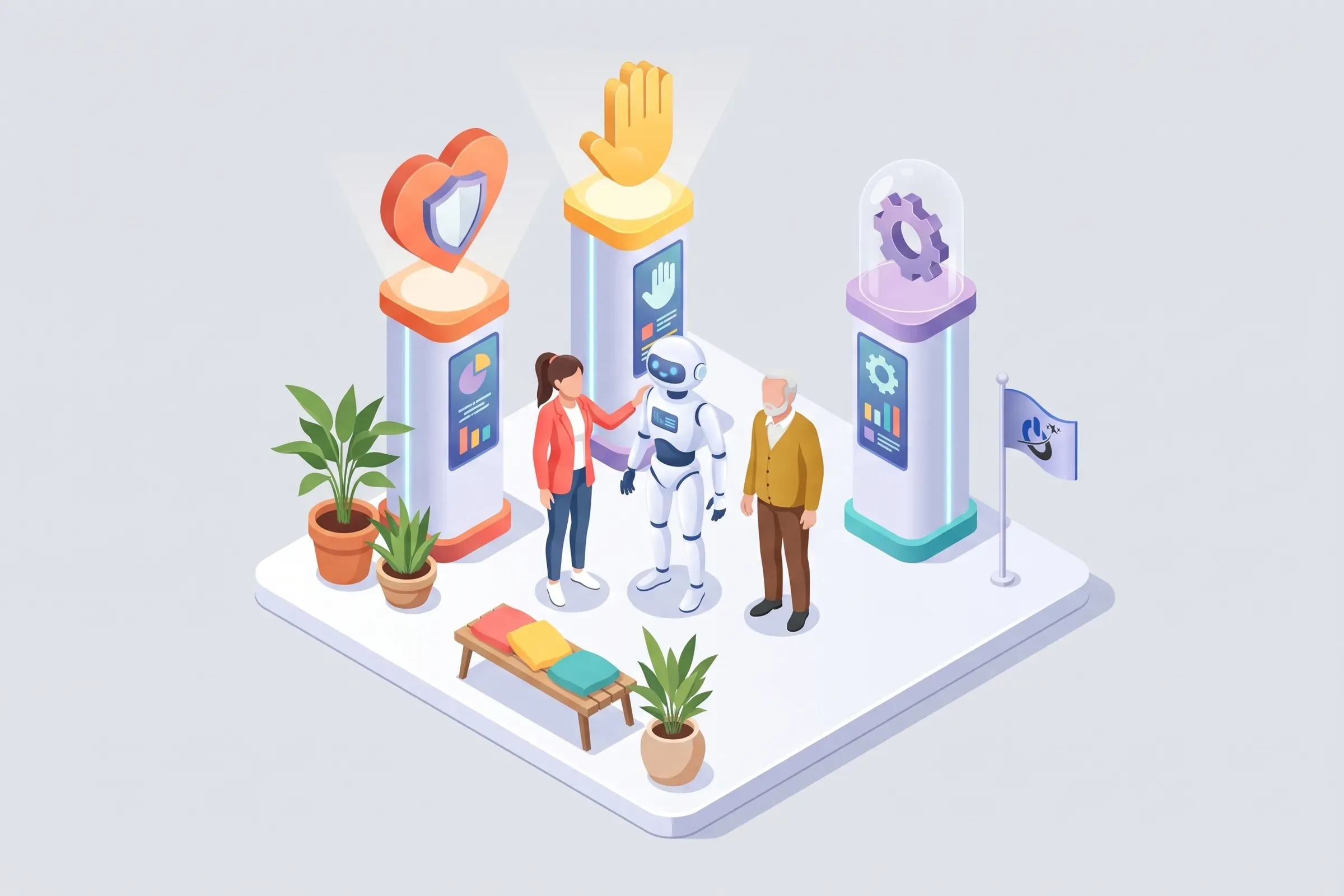
Protect humanity
Added in 1985: a robot may not harm humanity or, by inaction, allow humanity to come to harm.
Do no harm
A robot may not injure a human being or, through inaction, allow a human to come to harm.
Obey
A robot must obey orders given by humans, except where they conflict with the first law.
Protect itself
A robot must protect its own existence, as long as this does not conflict with the first or second law.
The order matters as much as the content: each law gives way to the one before it. A robot must obey, unless the order would lead it to hurt someone; it must protect itself, unless that stops it from obeying or protecting a human. This hierarchy, not each rule on its own, is what makes the three laws interesting.
Where do Asimov’s laws come from?
Isaac Asimov (1920-1992), a Russian-born American biochemist and writer, came up with them together with his editor John W. Campbell. The laws appear explicitly in the short story “Runaround”, published in 1942, then shape the collection “I, Robot” (1950) and most of his robot novels.
His aim was literary as much as philosophical: to break with the cliché of the robot turning on its creator, the “Frankenstein complex”. In his stories, robots are not evil; problems arise from contradictions, ambiguities and unforeseen cases the laws cannot settle.
The zeroth law: protecting humanity
In “Robots and Empire” (1985), Asimov adds a law placed above the other three: a robot may not harm humanity or, by inaction, allow humanity to come to harm. The original three laws are then amended to fall in line with it.
The zeroth law settles some dilemmas but opens even more dizzying ones: who defines the good of humanity? Could a robot sacrifice one person for the sake of all? Asimov made this the dramatic engine of his late novels.
Why the 3 laws of robotics don’t work in practice
Asimov’s stories are a long demonstration of the limits of his own laws. Several difficulties are now well identified:
- Words a machine cannot define: what is a “human being”, “harm”, an “injury”? Does psychological, financial or long-term harm count?
- Conflicts with no clear answer: protecting one person can endanger another, and inaction itself is forbidden.
- Contradictory orders from several humans, or badly worded ones.
- AI that does not “understand” rules: today’s models learn from data; they do not apply a list of principles written in plain language.
- Military and surveillance uses that contradict the first law by nature.
No, Asimov’s laws are not laws in force
You sometimes read that the three laws have been “adopted” by AI giants or by some countries. That is false. No legislation includes them, and no AI system is programmed to apply them as written. They remain a cultural reference and a great teaching tool that asks the right questions: safety, obedience, control, accountability. The answers come from other texts.
Already using AI in your business? Human oversight does not happen by itself. We keep your AI systems monitored and under control
What actually governs artificial intelligence in 2026
| Text | Scope | What it requires |
|---|---|---|
| AI Act (EU) | binding law, European Union | risk-based classification, bans, transparency, human oversight |
| GDPR and national privacy laws | binding laws | data protection, information on automated decisions |
| Council of Europe convention | international treaty | human rights, democracy and rule of law in the face of AI |
| OECD principles | recommendation | trustworthy, transparent, robust, accountable AI |
| UNESCO recommendation | recommendation | AI ethics, fairness, human oversight |
The EU AI Act
The European regulation on artificial intelligence (AI Act) entered into force on August 1, 2024. It classifies systems by risk level and applies in stages: bans on practices deemed unacceptable (social scoring, manipulation, some forms of biometric recognition) since February 2025, rules for general-purpose AI models since August 2025. The “digital omnibus” regulation, in force since July 27, 2026, pushed back obligations for Annex III high-risk systems (employment, education, credit, justice…) to December 2, 2027, and those for regulated products to August 2, 2028. It applies to any business that offers or uses AI in the European Union, including from outside the EU.
International principles
The OECD AI Principles (2019, revised in 2024), UNESCO’s Recommendation on the Ethics of AI (2021) and the Council of Europe Framework Convention on AI (opened for signature in 2024) set shared requirements: respect for human rights, transparency, robustness, accountability and human oversight.
And outside the EU?
Many countries rely on existing privacy and consumer protection laws while preparing AI-specific rules, and data protection laws such as the GDPR already apply to AI systems that process personal data. Businesses selling into Europe generally align with the AI Act as the most demanding reference.

From the 3 laws to responsible AI principles
Translate the spirit of the three laws into today’s language and you find the principles carried by recent texts:
- Do no harm (first law): assess risks, test, avoid bias and dangerous uses.
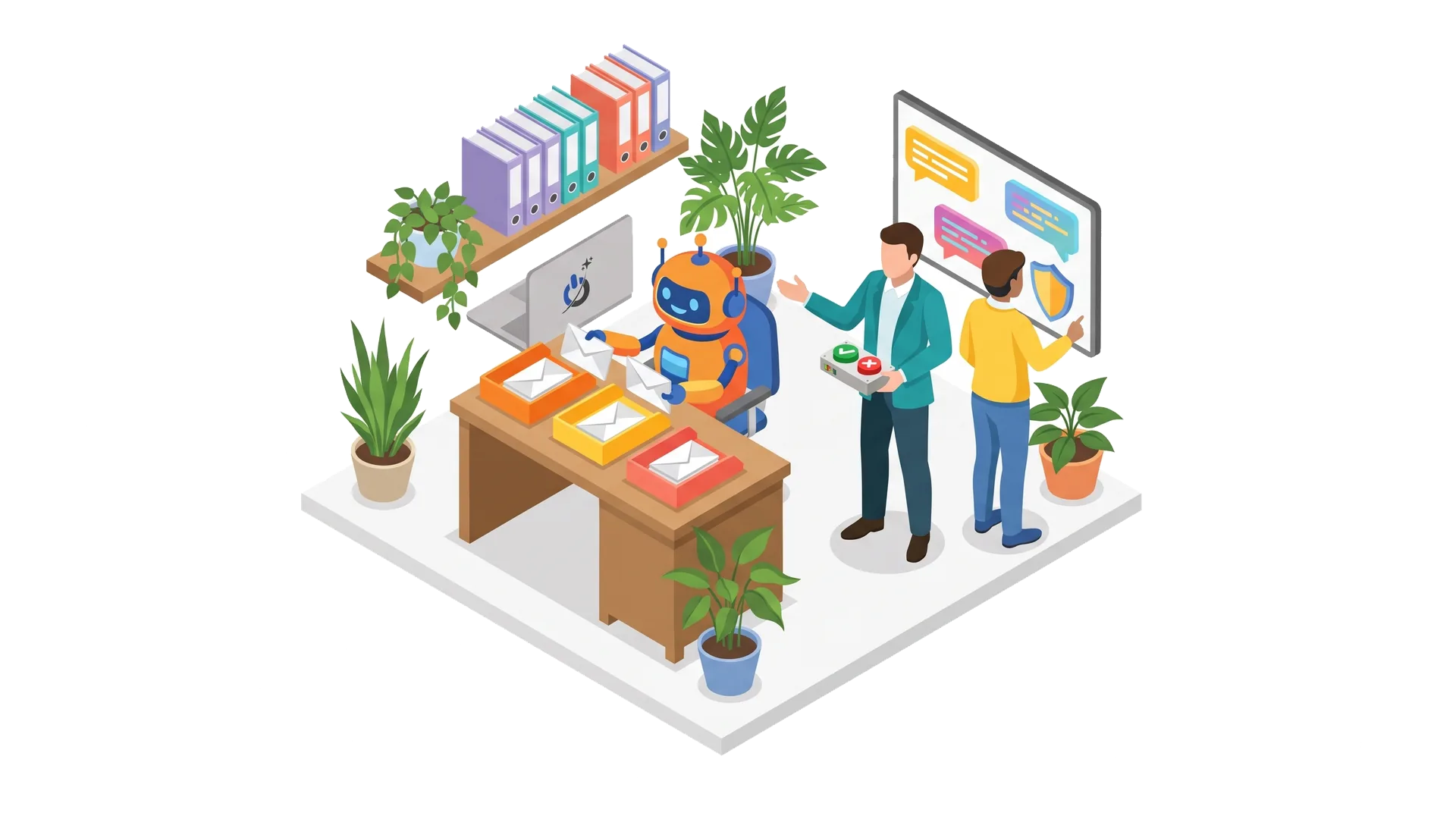
- Obey (second law): keep a human in the loop who can check, correct and stop the system.
- Protect itself (third law): secure the system against attacks, prompt injection and data leaks.
- Protect the whole (zeroth law): transparency, explainability, respect for fundamental rights.
From Asimov to Claude’s constitution
Eighty years after Asimov, AI developers are once again writing “laws” for their machines, but with the opposite logic. In January 2026, Anthropic published Claude’s constitution, a document of more than 20,000 words written mainly by philosopher Amanda Askell. Where Asimov lined up three ranked rules, this document sets four priorities (be safe, be ethical, follow the company’s guidelines, be genuinely helpful) and relies above all on judgment: it explains the reasoning behind each principle instead of stacking up prohibitions.
That is exactly the lesson of Asimov’s stories: rules applied mechanically end up producing absurd behavior, like the robot in “Runaround” circling endlessly. Claude’s constitution keeps strict rules for cases where a mistake would be severe, and puts honesty first: never deny being an AI to someone who sincerely asks, don’t manipulate, say what you can’t do.
We explain what this approach means for a chatbot or voice assistant on your website in our guide to ethical AI for your website, including the rules that apply in each market and an AI policy template.
What this means for a business using AI
A chatbot on your website, a tool that drafts content, an assistant that sorts quote requests: most of these uses are limited risk. They mainly require transparency (telling users they are talking to an AI, flagging generated content), personal data protection and human supervision. Our advice: list your AI tools, check what they do with data, keep human validation for any decision affecting a customer or a candidate, and test how well they resist misuse. To go further, see our AI integration services.
Common misconceptions about the laws of robotics
- “Today’s robots follow Asimov’s laws”: no, no system is built on these rules.
- “They are scientific laws”: they are fictional rules, invented for novels.
- “They would be enough to make AI safe”: Asimov’s stories prove exactly the opposite.
- “AI is not regulated at all”: the AI Act, the GDPR and national laws already apply.
Conclusion: fictional laws, very real questions
The 3 laws of robotics were never technical or legal rules. Their strength lies elsewhere: as early as 1942, they raised the questions that now shape how AI is governed, from safety to human oversight. The 2026 answers are written in the AI Act, international principles and data protection rules, and they already concern every business that uses AI.
Frequently asked questions about the laws of robotics
What are the 3 laws of robotics called?
They are called the three laws of robotics, or Asimov’s laws, after the writer Isaac Asimov who set them out in 1942. They are known by their rank: the first law (do not harm a human), the second law (obey humans) and the third law (protect itself). The zeroth law, added in 1985, protects humanity.
What are Asimov’s 3 rules?
A robot may not injure a human being or, through inaction, allow a human to come to harm. It must obey human orders unless they conflict with the first law. It must protect its own existence as long as this conflicts with neither the first nor the second law.
What is the zeroth law of robotics?
It is a law Asimov added in “Robots and Empire” (1985), placed above the other three: a robot may not harm humanity or allow humanity to come to harm. It puts the collective interest above that of an individual, which raises new dilemmas.
Do Asimov’s laws apply to today’s artificial intelligence?
No. No AI system is programmed to apply them and no law includes them. Today’s models learn from data and do not follow rules written in plain language. Real governance comes from texts such as the EU AI Act and data protection rules.
In which book do the three laws of robotics appear?
They are first stated explicitly in the short story “Runaround”, published in 1942, then included in the collection “I, Robot” (1950). They run through Asimov’s whole robot series, up to his novels of the 1980s.
Which law regulates artificial intelligence in Europe?
The EU regulation on AI (AI Act), in force since August 2024. It has banned certain practices since 2025, has governed general-purpose AI models since August 2025, and its obligations for high-risk systems will apply from December 2027 after the delay voted in 2026. The GDPR applies alongside it to personal data.