Ecommerce Email Marketing: 7 Email Flows That Drive Sales (Examples and Timing)
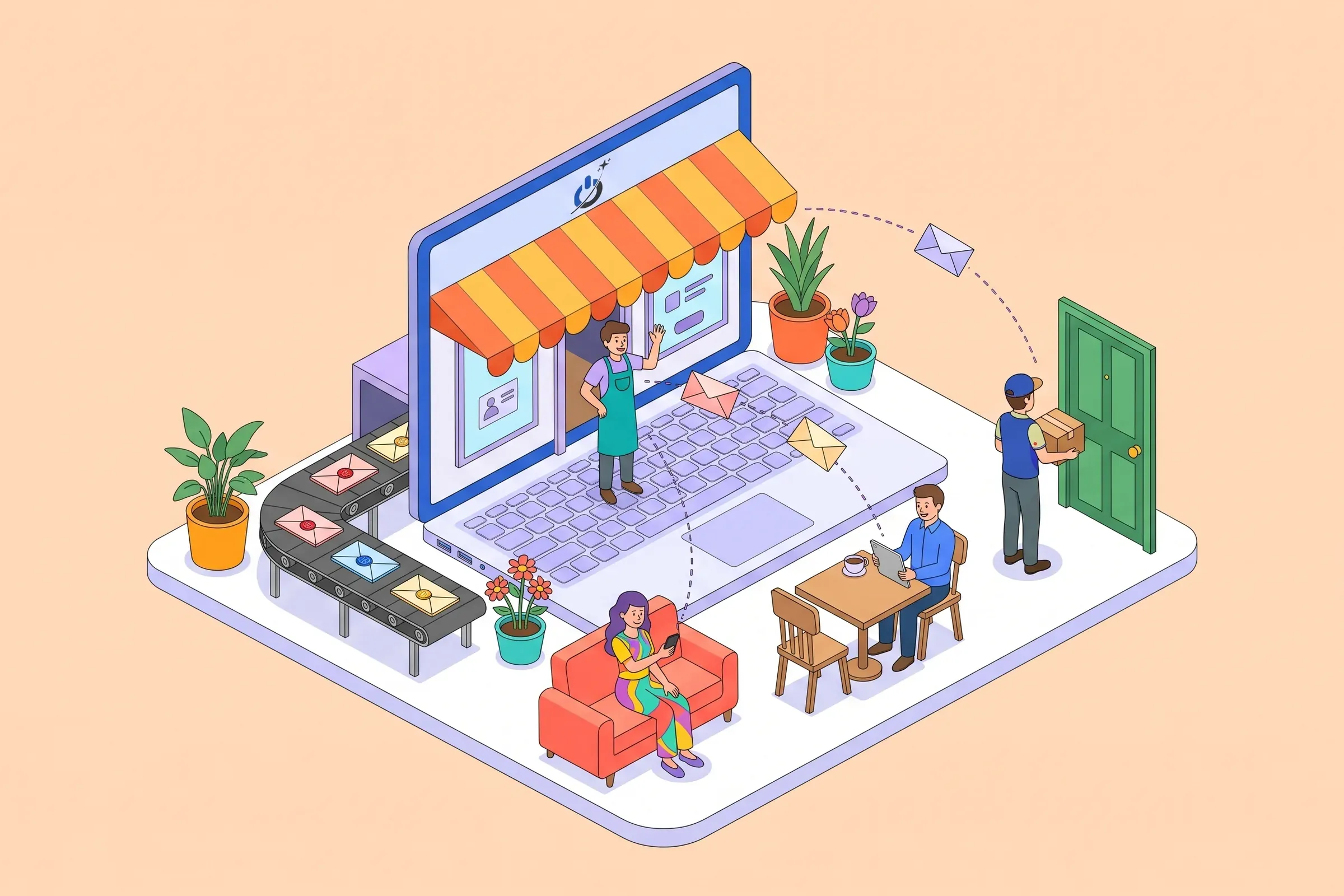
This guide covers the 7 email flows that generate the most sales for an online store (welcome, browse abandonment, abandoned cart, post-purchase, back in stock, urgency, win-back), with the right timing and what each should contain. We also look at how to write, segment, stay deliverable and compliant, and which metrics to track to run your email marketing for ecommerce.
At a glance
- Ecommerce email marketing relies on automated flows triggered by customer behavior.
- According to Omnisend, automated emails made up only 2% of sends in 2025 but 30% of email-driven revenue.
- Welcome and abandoned cart emails alone drive 76% of orders from automations.
- A good ecommerce email is personal, useful, well timed and easy to buy from on a phone.
- Deliverability, consent and segmentation shape results as much as content.
Why email marketing still pays off for ecommerce
Email has been declared dead for years, and it remains one of an online store’s most profitable channels. The reason is simple: you are talking to people who gave you their address, so they have already shown interest, without paying for each contact as you do with ads.
In ecommerce email marketing, the real lever is automation. According to Omnisend’s 2026 ecommerce marketing report, covering 150,000 brands and 27 billion emails sent in 2025, automated emails made up only 2% of sends but 30% of email-attributed revenue. They arrive when interest already exists.
The 7 email flows that drive sales
| Flow | Trigger | When to send | Goal |
|---|---|---|---|
| Welcome | newsletter sign-up or account creation | within minutes, then 2 or 3 emails over the week | first order |
| Browse abandonment | product viewed but not added to cart | the next day | bring them back to the product |
| Abandoned cart | cart not completed | after 1 to 4 h, then day 1 and day 3 | complete the purchase |
| Post-purchase | order placed and delivered | confirmation, shipping, then 5 to 10 days after delivery | review, loyalty, cross-sell |
| Back in stock | alert requested by the customer | as soon as the item is restocked | immediate purchase |
| Urgency | offer ending, limited stock, delivery deadline | 24 to 48 h before the deadline | decide now |
| Win-back | no purchase for about 6 months | a series of 2 or 3 messages | bring them back or clean the list |
1. The welcome email
It is the first contact after sign-up, and often the most opened email. It says thank you, reminds subscribers what they will receive and gives them a reason to buy: a first-order perk, your bestsellers, what makes your store different. Send it within minutes of sign-up, then plan two or three messages over the week to introduce your brand.
2. Browse abandonment
An identified visitor viewed a product several times without adding it to the cart. A short message the next day reminds them of the product and answers common questions (size, lead times, returns). Keep the tone light: the goal is to help, not to show you are watching.
3. Abandoned cart
This is the most profitable flow. More than seven carts in ten are abandoned, often because of costs revealed late, an account to create or a simple distraction. A sequence of two or three emails recovers part of these sales:
Our advice: do not put a discount in the first reminder. Many customers come back without one, and you avoid teaching your customers to abandon carts to get a deal. To tackle the causes too, see our cart abandonment guide.
4. Post-purchase emails
Order confirmations and shipping notices are the most-read emails. Use them without overloading them: a sincere thank-you, delivery tracking, usage tips. A few days after delivery, ask for a review, then suggest a relevant complementary product.
5. Back in stock
A customer asked to be notified? Send the alert as soon as the product is back. It is one of the best-converting messages: according to Omnisend, back-in-stock emails had the highest conversion rate of any automation in 2025, at 6.46%.
6. Urgency and fear of missing out
An offer ending, limited stock, guaranteed delivery before the holidays: the fear of missing out (FOMO) pushes people to decide. It works if it is true. A fake countdown or a “last day” repeated every week destroys trust.
7. Win-back
A customer has not bought anything in six months? A “we miss you” message, a new product matched to their past purchases or a targeted perk can bring them back. With no response after two or three attempts, remove them from regular sends: they drag down your deliverability.
Writing an ecommerce email that makes people want to buy
Flows are not everything: in ecommerce email marketing, the message itself matters as much as its timing.
- A clear subject line that says what the email contains, with preview text that complements it.
- One goal per email and one clearly visible main button.
- The product at the center: photo, name, price, and what reassures (shipping, returns, reviews).
- Designed for mobile: one column, readable text, a button big enough for a thumb.
- A tone that sounds like your brand, and a recognizable sender rather than a “no-reply” address.
Segment to send less, but better
Sending the same newsletter to your whole list is the surest way to tire your subscribers. Segment on what you actually know: new subscribers and customers, purchase frequency and value, categories bought, country and language, engagement level. A loyal customer and a subscriber who has never ordered do not expect the same message. Personalization is at the heart of the digital customer experience, and email is one of its first touchpoints.
Deliverability and consent: the foundations
The best email is useless if it lands in spam. Gmail, Yahoo and Outlook now require an authenticated domain (SPF, DKIM, DMARC), a low complaint rate and one-click unsubscribe. Our email deliverability guide explains how to comply.
On the legal side, the basic rule is consent: GDPR in Europe, Canada’s Anti-Spam Legislation (CASL), CAN-SPAM in the United States. Never buy a list.
A store well connected to your email tool changes everything. Discover our ecommerce website design
Which tools for ecommerce email marketing?
Most tools on the market handle the flows described here: Klaviyo, Omnisend, Brevo, Mailchimp or the tools built into Shopify and other platforms. The choice mainly depends on the connection with your store (syncing orders, products and carts), your contact volume and where your data is hosted. A well-integrated tool beats a feature-rich one poorly connected to your sales.
Measuring results
| Metric | What it measures | Watch |
|---|---|---|
| Click rate | interest generated by the content | subject line, visual, button |
| Conversion rate | the share of clicks that become sales | landing page, price, fees |
| Revenue per email sent | the real profitability of each flow | comparison between flows |
| Unsubscribes and complaints | your subscribers’ tolerance | frequency, targeting, relevance |
| Open rate | a trend, less reliable since privacy protections | interpret with caution |
To steer your ecommerce email marketing, compare flows with each other and over time: an abandoned cart email converting less than three months ago deserves a new subject line, timing or visual to test.
Where does your email marketing stand?
In short
Ecommerce email marketing pays off mainly through a few well-tuned automated flows: welcome, browse and cart abandonment, post-purchase, back in stock, honest urgency and win-back. They go out at the right moment, talk about what genuinely interests the customer and rest on a healthy, deliverable, consenting list. Set them up one by one, starting with abandoned cart and welcome, then measure and adjust.
Frequently asked questions about ecommerce email marketing
Which automated emails should an online store set up?
Start with the welcome email and the abandoned cart sequence, which generate most automation sales. Then add post-purchase emails (reviews, complementary products), back-in-stock alerts, browse abandonment and win-back for inactive customers.
Which email tool should I choose for an ecommerce site?
Klaviyo, Omnisend, Brevo, Mailchimp and the tools built into Shopify cover most needs. Choose first on the quality of the integration with your store, then on contact volume, budget and data hosting.
How do I keep marketing emails out of spam?
Authenticate your domain with SPF, DKIM and DMARC, email only consenting contacts, offer one-click unsubscribe and remove inactive or bouncing addresses. A low complaint rate and regular sending protect your domain’s reputation.
What rules apply to email marketing in Canada and Europe?
In Canada, CASL requires express or implied consent, sender identification and a working unsubscribe link. In Europe, GDPR and ePrivacy rules generally require prior consent for marketing to individuals, except for similar products offered to existing customers with an easy opt-out.
How do I measure an email campaign’s performance?
Track click rate, conversion rate, revenue per email sent, and unsubscribe and complaint rates. Open rate has become less reliable because of mailbox privacy protections. Compare your flows with each other and over time.
How often should I send newsletters to customers?
There is no universal rule: one to four newsletters a month suit most stores, on top of automated emails. Consistency and relevance matter most. Watch unsubscribes: if they rise, send less often or segment further.